Category: English

  • பிரபஞ்சத்தின் மகத்தான நூறு புதிர்கள் ! பிரபஞ்சம் ஒன்றா ? பலவா ?

     aj

    சி. ஜெயபாரதன் B.E.(Hons) P.Eng (Nuclear) கனடா

    +++++++++++++++++

    “வெறுமையிலிருந்து எதுவுமே உருவாக முடியாது.”

    லுகிரிடியஸ் ரோமானிய வேதாந்தி (Lucretius) கி.மு. (99-55)

    “நமது பிரபஞ்சம் பத்து பில்லியன் ஆண்டுகளுக்கு முன்பு மெய்யாகவே வெறுமையிலிருந்து தோன்றியதாக நான் அனுமானம் செய்கிறேன் ! . . .ஏன் அவ்விதம் நிகழ்ந்தது என்னும் கேள்விக்கு எனது தாழ்மையான முன்னறிவிப்பு இதுதான் : எப்போதாவது ஒரு யுகத்தில் அப்படி நேரும் தோற்றங்களில், நமது பிரபஞ்சமும் ஒன்று என்பது !”

    எட்வேர்டு டிரையன், பௌதிகப் பேராசிரியர் நியூயார்க் பல்கலைக் கழகம் (1975)

    “கவிஞன் அண்டக் கோள்களில் மண்டையை நுழைக்க வேண்டுகிறான். தர்க்கவாதி தன் மண்டைக்குள் அண்டங்களைத் தேடிச் செல்கிறான். அப்புறம் அவன் தலைதான் பிளக்கிறது.”

    ஜி.கே. செஸ்டர்ஸன் (G.K. Chesterson) (1874-1936)

    Multi-universe -1

    இணைப் பிரபஞ்சங்கள்

    இணைப் பிரபஞ்சங்கள் விண்வெளியில் உள்ளனவா ?

    விஞ்ஞானிகள் இப்போது நமது பிரபஞ்சத்தைப் போல ஓர் இணையான பிரபஞ்சம் (Parallel Universe) இருக்கலாம் என்று மெய்யாக நம்புகிறார்கள். புத்தகத்தில் படிக்கும் விஞ்ஞானப் புனைகதை இல்லை இது ! “Multiverse” என்னும் சொல்லை முதலில் ஆக்கியவர் அமெரிக்க வேதாந்தி வில்லியம் ஜேம்ஸ் (1848-1910). சொல்லப் போனால் நமக்குத் தெரியாமல் குறிப்பிட முடியாத எண்ணிக்கையில் இணையான “பல்லரங்கப் பிரபஞ்சங்கள்” (Multiverses) இருக்கலாம் என்று யூகிக்கப்படுகிறார்கள் ! நாம் அவற்றில் ஒன்றான நமக்குத் தெரியும், உப்பி விரியும் ஒரு பெருவெடிப்புப் பிரபஞ்சத்தில்தான் வாழ்ந்து வருகிறோம். அந்தப் பிரபஞ்சங்கள் காலவெளியும், மர்மமான, புதிரான பண்டங்களும் கொண்டிருக்கலாம் ! மெய்யாக நமது பிரபஞ்சத்தில் உள்ள ஈர்ப்பாற்றல் வலுவற்ற சமிக்கை மற்ற இணைப் பிரபஞ்சத்திலிருந்து கசிந்து புகுந்து விட்ட ஒன்றுதான் ! இதில் வியப்பென்ன வென்றால் இந்த இணைப் பிரபஞ்சம் நமது பிரபஞ்சத்துக்கு மிக்க அருகில் இருக்கலாம் என்றும் விஞ்ஞானிகள் கருதுகிறார்கள்.

    Superstring Universe

    பிரபஞ்சத்தின் பரிமாணங்கள் நான்கு அல்ல பதினொன்று !

    உன்னத இழை நியதி (Superstring Theory) பெருவெடிப்புக்கு முந்தய சில அடிப்படை விளைவுகளையும் விளக்க உதவுகின்றது ! ஒற்றை நியதியில் இழை நியதி பராமாணுக்கள், அடிப்படை இயற்கை உந்துவிசைகள் (Particles & Fundamental Forces of Nature) யாவும் உன்னத சீரான நுண்ணிழைகளின் அதிர்வுகள் (Vibrations of Tiny Supersymmetric Strings) என்று தெளிவாகக் கூறுகிறது. பரமாணுக்களின் அணுக்கூண்டில் இயங்கும் “நுண்துகள் ஈர்ப்பாற்றல்” (Quantum Gravity) தன்மைகளை விளக்கும் மகிமை கொண்டது இந்த உன்னத இழை நியதி ! இது ஏறக்குறைய உயிரியல் பிறவி மூலமான “டியென்னே” (DNA) போன்றது பிரமஞ்சத்தின் ஒற்றை உன்னத இழை நியதி என்று வைத்துக் கொள்ளலாம் !

    புரட்சிகரமான இந்த இணைப் பிரபஞ்சக் கோட்பாடு எப்போது உதயமானது என்னும் கேள்வி எழுகிறது இப்போது ! உன்னத இழை நியதி, பெருவெளி, கருமைப் பிண்டம் (Superstring Theory, Hyperspace & Dark Matter) ஆகிய புதிய கோட்பாடுகள் எழுதப்பட்டதும் பௌதிக விஞ்ஞானிகள் பிரமஞ்சத்தின் விஞ்ஞானத்தை விளக்க நாமறிந்த நான்கு காலவெளிப் பரிமாணங்கள் மட்டும் போதா வென்றும், அவை மெய்யாகப் பதினொன்று எண்ணிக்கைகள் என்றும் உணர்ந்தார்கள் ! அவ்வித முடிவுக்கு விஞ்ஞானிகள் வந்ததும், அடுத்தோர் முடிவும் உதயமானது ! அதாவது நாமறிந்த பிரபஞ்சமானது எண்ணிற்ற “சவ்வியல் குமிழிகளில்” (Membraneous Bubbles) ஒன்றானது ! சவ்வுக் குமிழிகள் பதினொன்றாம் பரிமாணத்தில் கொந்தளிக்கும் போது அலைகள் எழுகின்றன !

    Multiverse Raising

    பெருவெடிப்பு மீளும் காலவெளித் தொடர் நிகழ்ச்சி

    இப்போது குமிழிப் பிரபஞ்சங்கள் இரண்டு ஒன்றை ஒன்று தொட்டால் என்ன நிகழும் என்று நினைக்கிறீர்கள் ? பிரிட்டனில் கேம்பிரிட்ஜ் விஞ்ஞானி நீல் துராக் (Neil Turok), அமெரிக்காவின் பென்சில்வேனியா பல்கலைக் கழகத்தின் விஞ்ஞானி பர்ட் ஓவ்ரட் (Burt Ovrut), & பிரின்ஸ்டன் பல்கலைக் கழகத்தின் விஞ்ஞானி பால் ஸ்டைன்ஹார்ட் (Paul Steinhardt) ஆகிய மூவரும் அவ்விதம் இரண்டு குமிழிப் பிரபஞ்சங்கள் ஒரு யுகத்தில் தொட்டன என்று நம்புகிறார்கள் ! அதன் விளைவென்ன ? மெய்யாக ஒரு மிகப் பெரும் வெடிப்பு நேர்ந்து ஓர் புதிய பிரபஞ்சம் << நமது பிரபஞ்சம் >> பிறந்ததாம் ! அப்படி அவர்கள் அறிவித்ததும் உலக விஞ்ஞானச் சமூகத்திற்கு ஓர் அதிர்ச்சி உண்டானது ! அந்த விளக்கவுரை சம்பிரதாய பெருவெடிப்பு நியதியின் முகத்தைத் திருப்பி விட்டது !

    Multiverse -5

    அதாவது நாமறிந்த பெருவெடிப்பு மெய்யாக பிரபஞ்சத்தின் ஆரம்பகால முதற் தோற்றமில்லை. காலவெளிப் படைப்பு அதற்கும் முற்பட்டது; மேலும் பெருவெடிப்பு அடுத்தும் தொடராய் நிகழலாம் என்னும் புரட்சிகரமான ஓர் அதிசய பிரபஞ்சத் தோற்றங்களின் “காலவெளித் தொடர் நிகழ்ச்சியை” (Space-Time Chain Event) அவர்கள் எடுத்துக் கூறினார். பெருவெடிப்புகள் எப்போதும் நிகழலாம் ! இப்போது பிரபஞ்சத்தின் மூலத் தோற்றத்தை வைத்து நமக்கு எச்சரிக்கையாய்ப் பூதகரமான ஒரு பயங்கரக் கேள்வி எழுகிறது ! பிரபஞ்சக் குமிழிகள் ஒன்றை ஒன்றை மோதி நமது பிரபஞ்சம் தோன்றிய தென்றால் மீண்டும் அவ்விதம் மோதும் ஒரு வாய்ப்புள்ளதா ? பதினொன்று பரிமாணமுடைய அகில வெளியில் எந்த நிகழ்ச்சியும் ஏற்படலாம் !

    Multiverse -4

    நான்கு வகுப்பு வடிவ நிலைகளில் பிரபஞ்ச அமைப்புகள்

    “பல்லரங்கப் பிரபஞ்சம்” அல்லது “மேநிலைப் பிரபஞ்சம்” (Multiverse, Multi-Domain Universes or Meta-Universe) என்பது நிகழக் கூடிய பல்வேறு இணைப் பிரபஞ்சங்கள் பற்றிய ஓர் சித்தாந்தப் பௌதிகக் கோட்பாடு (Hypothesis of Possible Multiple Universes). அதனுள் நாம் வாழும் பிரபஞ்சமும் அடங்கும். அது ஒரு பௌதிக விஞ்ஞான மெய்ப்பாடுதான் ! பற்பல பிரபஞ்சங்களின் கட்டமைப்புகள் (Structures of the Multiverse), ஒவ்வொரு பிரபஞ்சத்தின் இயல்பான பண்பாடு (The Nature of Each Universe), பல்வேறு பிரபஞ்ச உட்பண்டங்களின் உறவுப்பாடு (The Relationship between the Constituent Universes), ஆகியவை குறிப்பிட்ட பிரபஞ்சத்தின் சித்தாந்த பௌதிகக் கோட்பாடைச் சார்தவை. “Multiverse” என்னும் சொல்லை ஆக்கியவர் அமெரிக்க வேதாந்தி வில்லியம் ஜேம்ஸ் (1848-1910). அவற்றை (Alternate Universes, parallel Universes, Quantum Universes, Parallel Worlds, Alternate Realities & Alternate Timelines) என்றெல்லாம் குறிப்பிடுகிறார்கள்.

    Parallel Universe

    பல்லரங்க பிரபஞ்சங்கள் வகுப்பு -1, வகுப்பு -2, வகுப்பு -3 & வகுப்பு -4 (Level I, Level II, Level III & Level IV) என்று நான்கு வகுப்புகளாகப் பிரிக்கப்பட்டுள்ளன. இந்தப் வகுப்பு முறைகளை ஆக்கியவர் மூவர் : 1. ஜியார்ஜ் எல்லிஸ் (George Ellis). 2. யு. கெர்ச்செனர் (U. Kirchner) & 3. டபிள்யு. ஆர். ஸ்டோஜர் (W.R. Stoeger). அப்பிரிவு முறைகளுக்கு “டெக்மார்க் வகுப்பியல்” (Tegmark Classification) என்பது பெயர்.

    1. பல்லரங்க பிரபஞ்சங்கள் (Multi-Domain Universes)

    வகுப்பு : 1 (திறந்த வெளிப் பிரபஞ்சம்)

    யுகங்கள் கடந்த பிரபஞ்சத்தின் எல்லையிலா அகிலவெளி வீக்கம் பற்றி ஒரு பூர்வீக முன்னறிவிப்புச் சித்தாந்தம் இது. அதனில் ஆதிகால நிபந்தனைகள் எடுக்கப்பட்டு ஹப்பிள் தொலைநோக்கி காணமுடிந்த கொள்ளளவுகள் இருக்க வேண்டும்.

    (Level : 1 A Generic Prediction of Cosmic Inflation is an infinite Ergodic Universe which, being infinite, must contain Hubble Volumes, realizing all initial conditions)

    Superstring Univers.

    2. வேறுபட்ட பௌதிக நிலைத்துவம் கொண்ட பிரபஞ்சங்கள் (Universes with Different Physical Constants)

    வகுப்பு : 2 (ஆன்ரி லிண்டேயின் குமிழ் நியதி) (Andrei Linde’s Bubble Theory)

    கொந்தளிக்கும் அகிலவெளி வீக்கத்தில் வெப்ப அரங்கங்கள் பரிமாணவியல், நுண்துகள் இருப்புகளுடன் வேறுபட்ட, வளப்பூட்டும் பௌதிக நிலைப்பாடுகள் அடைவது.

    (Level : 2 In Chaotic Inflation other Thermalized Regions may have different Effective Physical Constants Dimensionality & Particle Content. Also it includes Wheeler’s Oscillating Universe Theory)

    3. பல்வேறு பிரபஞ்சங்கள் (Multiverses)

    Multiverse -1

    வகுப்பு : 3

    நுண்துகள் யந்திரவியலை விளக்கும் போது சமத் தோற்றம் கொண்ட ஆனால் மாறுப்பட்ட தன்மையுள்ள பல்வேறு பிரபஞ்சங்களைப் பற்றிக் கூறுகிறது. 2007 செப்டம்பரில் டேவிட் டாய்ட்ஸ்ட் (David Deutsch) பல்வேறு உலகங்களைப் பற்றி விளக்கமும் நிரூபணமும் அளித்தார்

    (Level : III An Interpretation of Quantum Mechanics that proposes of Multiple Universes which are identical but exist in possibly different States)

    4. முடிவான முழுத்தோற்றப் பிரபஞ்சங்கள் (Ensemble Theory of Tegmark – Ultimate Ensemble)

    வகுப்பு : 4 மற்ற கணித அரங்குகள் வெவ்வேறு அடிப்படைப் பௌதிகச் சமன்பாடுகளை உண்டாக்குகின்றன.

    (Level : IV Other Mathematical Structures give different fundamental Equations of Physics)

    எண்ணற்ற பிரபஞ்சங்களின் குமிழ்க் கோட்பாடு (Bubble Theory of Infinite Universes)

    Level IV Universes

    வகுப்பு -2 இல் வரும் அகிலவெளி வீக்கத்தில் தோன்றும் பொருத்தமான குமிழ்ப் பிரபஞ்சங்களைப் பற்றி ஆன்ரி லிண்டே எடுத்து விளக்கினார். விஞ்ஞானிகள் பலர் ஒப்புக்கொண்ட கோட்பாடி இது. இந்த கோட்பாடு கூறுவது என்ன ? நுண்துகள் திரட்சி நுரையிலிருந்து (Quantum Foam) ஒரு “தாய்ப் பிரபஞ்சத்திலிருந்து” (Parent Universe) மற்ற பிரபஞ்சங்கள் உதித்தன என்பதே !

    “இணையான உலகங்கள்” என்னும் நூலை எழுதிய ஜப்பானிய அகிலவியல் மேதை மிச்சியோ காக்கு (Parallel Worlds By : Michio Kaku) தான் 2004 இல் வெளியிட்ட கட்டுரையில் பின்வருமாறு கூறுகிறார்:

    நான் எழுதிய “இணையான உலகங்கள்” நூலில் காலவெளி அமைப்புகளை விளக்குவதற்குப் பதிலாக கடந்த பல ஆண்டுகளில் வளர்ந்த அகிலவியல் உளவுப் புரட்சிகளைக் குறிப்பாகக் காட்டுகிறேன். முதல் பாகத்தில் பிரபஞ்சத்தைப் பற்றியும், முற்போக்கான அகில வீக்கம் பற்றியும் கூறி முடிவில் பெருவெடிப்புடன் முடிகிறது. இரண்டாம் பாகத்தில் பல்லரங்கப் பிரபஞ்சங்கள் பற்றி எழுந்த கோட்பாடுகளை விளக்கி பரிமாண எண்ணிக்கை விரிவானது பற்றியும், உன்னத இழை நியதி பற்றியும் கூறுகிறேன். மூன்றாவது பாகத்தில் எப்படிக் கோடான கோடி ஆண்டுகளுக்குப் பிறகு பிரபஞ்சம் குளிர்மயமாகி முடிவடையும் என்பதை விளக்கம் செய்கிறேன்.

    Multiverse -2

    இணைப் பிரபஞ்சங்கள்

    +++++++++++++++++++

    1.  http://www.bing.com/videos/search?q=multiverse+parallel+universe&qpvt=Multiverse+parallel+universe&FORM=VDRE
    2.  https://youtu.be/aUW7patpm9s
    3.  https://youtu.be/z4rifLtsrX4
    4.  https://youtu.be/EwQEBWepRlY
    5.  https://youtu.be/Ywn2Lz5zmYg

    (தொடரும்)

    *****************************

    Image Credits : Scientific American (May 2003)

    தகவல்:

    1. Astronomy’s Explore the Universe 8th Edition (2002) December 31, 2001

    2. National Geographic Magazine (1982) Frontiers of Science The Family of the Sun By: Bradford Smith Ph. D. Professor of Planetary Sciences, The University of Arizona.

    3. National Geographic Magazine (1975) Amazing Universe, The Family of Stars By: Herbert Friedman.

    4. Internet Article “Stellar Evolution”

    5. Majestic Universe By: Serge Brunier (1999)

    6. Neutron Stars & Pulsars -From the Internet Sources (December 2006)

    7. Parallel Universe – BBC Information (February 14, 2002)

    8. Scientific American “Parallel Universes” By Max Tegmark, Professor of Physics & Astronomy, University of Pennsylvania (May 2003)

    9. Parallel Worlds (The Science of Alternate Universes & Our Future in the Cosmos) By : Michio Kaku (2005)

    10. 50 Greatest Mysteries of the Universe – Astronomy Magazine (August 21, 2007)

    11.  http://www.scientificamerican.com/article/multiverse-the-case-for-parallel-universe/

    12.  http://www.bing.com/videos/search?q=multiverse+parallel+universe&qpvt=Multiverse+parallel+universe&FORM=VDRE

    13. http://www.dummies.com/how-to/content/string-theory-parallel-universes-and-the-multivers.html

    14. http://www.npr.org/2011/01/24/132932268/a-physicist-explains-why-parallel-universes-may-exist  [January 24, 2011]

    15.  https://en.wikipedia.org/wiki/Multiverse   [July 12, 2016]

    *******************************

    S. Jayabarathan (jayabarathans@gmail.com) July 12, 2016

    Attachments area
    Preview YouTube video Multiverse: One Universe or Many?

    Multiverse: One Universe or Many?

    Preview YouTube video MULTIVERSE AND PARALLEL UNIVERSES – Discovery Life Universe (full documentary)

    MULTIVERSE AND PARALLEL UNIVERSES – Discovery Life Universe (full documentary)

    Preview YouTube video Parallel Universe or Multiverse Theory Documentary: Why we may Live in a Multiverse

    Parallel Universe or Multiverse Theory Documentary: Why we may Live in a Multiverse

    Preview YouTube video The True Science of Parallel Universes

    The True Science of Parallel Universes
    Share
  • குதிரையை எனக்குப் பிடிக்கும்

     மதுமிதா

    10518674_307423642786795_5858810718641257109_o

    குதிரை வண்டியில் பள்ளிக்குப் போவதற்கு முன்பே
    இசைக்கேற்ற ரசனை சார்ந்த நளின அசைவுகளுடனான
    உன் நாட்டியத்தை சர்க்கஸில் பார்த்திருந்தேன் சிறுமியாய்

    குழந்தையை முதுகில் தாங்கிய ஜான்ஸிராணியின் படத்தைக்
    கண்டதிலிருந்து நானே உன் மீது பவனி வருவதாய் உணர்வு

    இலக்கியங்களில் உன் மீதமர்ந்து வருபவர்களை வாசிக்கையில்
    திரையில் குதிரையில் பாடிக்கொண்டே பவனி வரும்
    கதாபாத்திரங்களை காண்கையில் உன் மீதான நேசம் மிகுந்தெழ
    உன்னில் எப்போதும் பயணித்தேன்

    உன் பக்கப்பார்வை மறைக்கப்பட்டு
    கட்டுப்படுத்துபவனுக்குக் கீழ்ப்படிந்தே நடக்கிறாய்
    ஆற்றல் நிறை பெண்ணுக்கோ குடும்பம் கடந்து,
    சமூகப்பார்வை மறைக்கப்படுகிறது

    குதிரைப் பந்தயத்தில் காற்றாய் பறக்கும் உன் வேகத்தைத் துறந்து
    சதுரங்கத்தில் குறைவான கட்டங்களிலான உன் நகர்வு
    சமயலறைக்கும் படுக்கையறைக்குமான
    என் நகர்வினை நினைவுபடுத்த
    நானும் நீயும் ஒன்றெனும் பிணைப்பு
    இன்னும் என் நினைவுகளில் வலுவினை சேர்க்கச் சேர்க்க

    குதிரையே உன்னை இன்னும் இவ்வளவு பிடிக்கும்.

    The poet reflects her affinity towards horses, from her early childhood. The similarities between a horse and a woman is compared here poetically.

    31.08.2015

    The Horse is to my liking
    Published by: shanmugam on 4th Oct 2015 
    Even before going to school by cart
    Drawn by the horse, I know you as a child,
    As you did dance to the tune in the circus.

    Ever since I saw Queen Jansi with her child
    On her back in the picture, I felt riding you.

    Reading characters in literature
    As riding, and seeing on the screen heroes
    Riding about on horses with singing,
    I rode you in mind with passion built up.

    Your sight of side views blocked by side screens,
    You behave obeying to your controller.
    To the versatile women being house bound,
    Societal outlook beyond home is denied.

    Your moves designed to a few squares in Chess,
    Far from your windy speed in the horse race,
    Reminds me of my moves between the kitchen
    And the bedroom, which strengthens my feelings
    That you and I are in a bind by all,
    And dear horse I love you still more so much.

    By (in Tamil):
    Mrs. Madhumitha
    In Anthology, Poetic Prism, 2015

    Translated to English by Rm Shanmugam


    குதிரையை எனக்குப் பிடிக்கும் – (2)
    குதிரையை எனக்குப் பிடிக்கும்.

    குதிரைவண்டியில்
    பள்ளிக்கூடத்திற்குப் போவதற்கு முன்பே
    சிறுமியாய் உன் நாட்டியத்தை
    முதன் முதலில் சர்க்கஸில் பார்த்திருந்தேன்
    குழந்தையை முதுகில் தாங்கி
    போருக்குச் சென்ற ஜான்ஸிராணியின் படத்தை
    பாடப் புத்தகத்தில் கண்டதும்
    நானே உன் மீது பவனி வருவதாய் உணர்வு

    குதிரையில் பாடிக்கொண்டே பவனி வரும்
    கதாபாத்திரங்களை திரைப்படத்தில் கண்ட போதெல்லாம்
    உன் மீது அன்பு நேசம் அதிகரிக்க
    போர்க்களத்தில் விழும் அவலம் காண நேர்கையில்
    பதைபதைப்பு உலுக்கும்

    சம்யுக்தையை உன் மேல் தூக்கிச் சென்று
    பிருத்விராஜன் கடிமணம் புரிந்ததையும்
    குதிரையை அடக்கிய தேசிங்குராஜனின் கதையையும்
    கல்கியின் கதாபாத்திரங்கள் உன்னில் பவனி வந்ததையும் அறிந்த போதும்
    ‘ஞானிகளுணர்வினொன்றாய்’ என்று
    உன்னைப் பற்றிய கம்பனின் உவமையாலும்
    உன் மேல் ஏறி வந்த மதுராவிஜய கங்காதேவியை
    காவல் கோட்டத்தில் தரிசித்த பிறகும்

    உன்னில் எப்போதும் பயணித்தேன்,
    எப்போது உன்னை நேசித்தேன் என்பதறியாமலே.

    உன் பக்கப்பார்வை மறைக்கப்பட்டு
    கட்டுப்படுத்துபவனுக்குக் கீழ்ப்படிந்து நடக்கிறாய்
    ஆற்றல் நிறை பெண்ணுக்கோ குடும்பம் கடந்து,
    சமூகப்பார்வை மறைக்கப்படுகிறது.
    காற்றாய் பறக்கும் வேகம் துறந்து
    சதுரங்கத்தில் உன் நகர்வு குறைவான கட்டங்களில்,
    சமயலறைக்கும் படுக்கையறைக்குமான
    என் நகர்வினை நினைவுபடுத்த
    நானும் நீயும் ஒன்றெனும் நினைவு,
    இன்னும் நம் பிணைப்புக்கு வலு சேர்க்கச் சேர்க்க


    Share
  • சங்க இலக்கியப்பாடல்களில் சாதி, தீண்டாமை, இன்ன பிற … .

    FL18_BK_TAMIL_jpg_2531435g

    The book makes a thorough examination of the issues of caste and untouchability, on the basis of grammar and in the context of Sangam age literary works. By INDIRA PARTHASARATHY

    THE slender, 77-page volume, Sangap Padalgalil Saadhi, Theendamai, inna pira… (Caste, untouchability, etc., in Sangam poetry) by Dr V.S. Rajam, the eminent Tamil grammarian and an invocative scholar in Indology, discusses in depth whether the concepts of caste and untouchability, as understood today in the context of early Sanskritic texts, existed during the Sangam period (from first century BCE to the succeeding three centuries) in Tamil Nadu.

    Caste is a unique thing, an intrinsic aspect of Hinduism associated with it from time immemorial. It started as “ us” and “them” in the early Rg Vedic society—“us” indicating themselves, the Aryans, or the new settlers, and “them” referring to the natives, or the old inhabitants, presumably, Dravidians—and later, two became four by compulsions of history, laying the foundation for “varnashrama dharma”.

    The Purusha-Sukta (hymn 10.90 of the Rg Veda) is about the purusha (the primeval man), the cosmic giant, getting dismembered in the Vedic sacrifice. The four classes of Hindu society, according to it, originated from his body. From his mouth was born the priest (Brahmin, master of the sacred speech), his arms became the Raja, the ruler (warrior, or the Kshatriya class), his thighs formed the Vaishya (merchants and farmers), and from his feet were born the Shudras (the servants and those who performed menial work). The fifth class, or the lowest section of the people in the social hierarchy, did not exist in early Vedic society. But as the nomadic Aryans started gradually dominating throughout India from the north to the south, indigenous tribes such as Nishadas, Chandalas and Mundas became so marginalised that they lived outside of what was known as the Vedic class. They had no social privileges and were treated as outcasts but were engaged by those socially superior to them to do all the dirty and unclean work. This led to the social practices of “pollution” and “untouchability”. Job and caste got integrated and the dharma sastras (law codes of Hinduism) later laid down that as one could not escape his destiny, his job was determined by the caste into which he was born. The obnoxious system of “untouchability” has been in existence in Hindu society for thousands of years. Though it has been legally banned, a good percentage of people in our country are yet to get over their shameful prejudices and petty sense of superiority.

    Dr B.R. Ambedkar, the founding father of the Indian Constitution, who fought relentlessly against this evil practice, knew what it meant to be an untouchable because he was born into the Mahar caste, whose members were treated as untouchables. He has written a valuable dissertation about the caste system in India. His strong faith was that the caste system would not stand the test of time because caste distinctions were fictions created by the then ruling castes and that times had changed. But the legitimate question is, have the times changed? Ambedkar would not have anticipated that in post-Independence India, instead of religionists, crafty politicians would keep the caste system alive and revive it time and again in conformity with their vote-bank politics. On the basis of their good knowledge of Sanskrit and perhaps, not so well-versed in Tamil, many European and American Indologists have argued that the caste system and the ugly practice of untouchability did exist in Tamil Nadu during the Sangam period.

    Tamil grammar is totally different from the grammar obtaining in other Indian languages. With logic as its strength, Tamil grammar analyses the structure of words in all its multidimensional aspects. Rajam, whose forte is grammar, probes whether caste meant the same during the Sangam period as we understand it today, and if not, at what point of time could the change have occurred. The book makes a thorough and in-depth examination, first on the basis of grammar and later in the context of literary works belonging to that era, of caste and untouchability.

    According to Rajam, the earliest Tamil grammar divides the living thing on the basis of intelligence, species and habitat; and in the case of human beings, the profession to which one belongs. The commentator for Tolkappiyam, a work on Tamil grammar, uses the word “kulam”, which stands for “guild” and not “caste”. He uses the word “peyar” , which may mean name, but here it stands for identity based on his geographical belonging, family, group, job, physically identifiable factors, and his status in the family, that is, whether a father or a son. In fact, it is a sort of unique identity card, to put it in the modern context. But the important thing one should notice is that jati (caste) refers only to the species, not to one’s community as it is understood now.

    Analysing the names by which one is referred to in Sangam anthologies, Rajam writes that thudiyan and paraiyan are those who beat the drums. The names do not refer to a person’s caste. Koothan is a dancer. Panan and padini are singers. There were no restrictions with regard to their social movements and they were treated as equals.

    Western missionaries compiled their dictionaries without bothering to refer to early Tamil literature, and abused the words pulaiyan and pulaithi by giving them meanings that were current during their period. In Sangam poems, a pulaiyan is a drummer or one who is involved with funeral rites. But, invariably, all the Western scholars have described him as one belonging to the most despicable class of people, on the lowest rung of the social ladder, and branded him as an untouchable. Rajam quotes chapter and verse from many Sangam poems to show that all the words that came to be identified with a caste or used as a degrading” form of reference in the later years, were actually words of distinction and honour during the Sangam period.

    Beef-eating was not a taboo in the Sangam period. Poets, singers and dancers enjoyed their drink and meat. The bards and those who played the different percussion instruments for various occasions, be it funeral or festival, were free to socialise with anyone, irrespective of class distinctions. The practice of untouchability was unknown.

    Brahmanisation of the Tamil social culture started in the Bhakti period and brought in its wake caste divisions and untouchability, as evidenced by the devotional works of the Saiva and Vaishnava saints. Rajam quotes the Vaishnava saint Nammalvar to prove her point.

    Nammalvar asks: “What though the person is lower in status, below the ordained four castes, be of lowly birth, even a Chandala of the lowliest Chandalas, if he is a devotee of my discus-bearing gem-lord, his servant’s servant shall be my lord, just see.” So, it is evident that they were the “lowliest of the low” during his time and it is ironic that Nammalvar pleaded for their salvation referring to them in the most contemptuous manner. Rajam has raised several scholarly questions with regard to this issue that needs to be addressed by others engaged in Indological research, which would go a long way in sharpening our historical perceptive in the context of literary studies.

    நன்றி : http://www.frontline.in/books/insightful-study/article7603238.ece

    Share
  • PEACE RALLY

    A4__3 copy

    UNITY OF THE WORLD PEACE <unityoftheworldpeace@gmail.com>


    Coming September 21st, We Are conducting Peace Rally For ” World Peace Day “.

    **  I HOPE YOUR PEACE NEWS LETTER PLEASE SIR **

    MY ALL PEACE FRIENDS,
    Corporate Social Responsibility ( CSR )
    All NGOs
    Schools And Colleges
    Social Workers ( Awareness Promoters )
    And All Public PeopleAll These Above Peoples Are Participating In Peace Rally

    The Very Biggest Unity Function In chennai Marina Beach Is Peace Rally, We Do This Without Any Variations And Personality.
    People Who Is Born As A Human Being Will Like To Participate In Peace Rally

    Detail Of September 21st ::  WORLD PEACE DAY
    Last Day Of Second World War. Human Being, Animals, Naturals Are Waiting For This Day And Even God Also!
    Please Care Peace

    Please Share This Value Calendar Day September 21 WORLD PEACE DAY To Your Family, Friends, Neighbours And Students ( Future Is In Human Hand )

    * PEACE RALLY *

    Date : 21.09.2015
    Time : 6.30 am
    Venue: Marina Beach – Chennai
    Starting From Mahatma Gandhi Statue To Labour Statue
    Dress Code: white Shirt ( White Tops )
    Organised By :UNITY OF THE WORLD PEACE ( NGO – NPO )
    RUN BY :: T.S. Arunachalam Charitable Trust
    CARE BY :: Friends Of People
    And
    Lions Club Of Chennai Periamet ( District 324- A1 )

    Invited By :

    Peace Ln A. KISHORE KUMAAR
    E MAIL ID: unityoftheworldpeace@gmail.com

    MOBILE  / WHATSAPP :: 9444475666.

    HUMAN UNITY + ANIMAL LOVE + NATURAL CARE = WORLD PEACE.

    ​

    ​​

    ​​

    ​​

    ​​

    ​​

    ​​

    ​​

    ​​​

    ​​

    ​​

    ​
    ​

    ​

    12 Attachments

    Preview attachment 12 x 3___5.tif

    12 x 3___5.tif
    Not virus scanned

    Preview attachment A4__2 copy.jpg

    A4__2 copy.jpg

    Preview attachment A4 world peace day.JPG

    A4 world peace day.JPG

    Preview attachment 12 x 3___3.tif

    12 x 3___3.tif
    Not virus scanned

    Preview attachment A4 copy.jpg

    A4 copy.jpg

    Preview attachment 12 x 3.tif

    12 x 3.tif
    Not virus scanned

    Preview attachment 6 x 4__10nos.tif

    6 x 4__10nos.tif

    Preview attachment A4__3 copy.jpg

    A4__3 copy.jpg

    Preview attachment 12 x 3___4.tif

    12 x 3___4.tif
    Not virus scanned

    Preview attachment 12 x 3___2.tif

    12 x 3___2.tif
    Not virus scanned

    Preview attachment PEACE RALLY copy.jpg

    PEACE RALLY copy.jpg

    Preview attachment Kaavalar – August – 2015 – Final.pdf

    Kaavalar – August – 2015 – Final.pdf
    Share
  • TIMES OF INDIA – Interview

    Crazy Mohan


    crazy1


    crazy

    crazy3


    crazy4


    Share
  • MONKEYS

    -Niveditha

    MonkeyMonkeys live all over the world and come in different shapes, sizes and colors. Monkeys are mammals. They are our closest relatives because they act just like humans. Monkeys are very intelligent and have opposable thumbs allowing them to use tools and play games. There are more than 260 different types of monkeys. They are separated into two large groups: Old world and new world. Old world monkeys live in Africa and Asia while new world monkeys live in the Americas. One difference between the two groups is that old world monkeys don’t have grasping tails but, new world monkeys do. Also, old world monkeys’ nostrils are small, curved and set close together while most new world monkeys have round nostrils set far apart.

    Diet

    Most people think monkeys only eat bananas but, that isn’t really true. Monkeys are omnivores. This means they eat meat and plant based foods. Majority of the monkeys eat nuts, fruits, seeds and flowers. Some of the monkeys also eat meat in the form of bird’s eggs, small lizards, insects and spiders.

    Habits & Habitat

    Most monkeys live on trees but, some monkeys live in savannas or mountain areas. Monkey tribes keep moving to find more food so, one location isn’t home for very long. Monkeys are very social animals. Groups of monkeys are called tribes, missions, troops or cartloads. A troop will work close together to take care of the young and little monkeys in the group. The monkeys also like to play, cuddle and protect each other. The strongest, bravest and largest male monkeys are the leader of the group. In monkey genus groups (a large group of monkeys like a subfamily) that practice polygyny, the leader will mate with multiple females.

    Offspring

    The pregnancy periods for monkeys Vary depending on the genus. For example, the pregnancy for a rhesus monkey is 164 days. Baboons have a similar pregnancy period of around 187 days. Chimpanzees on the other hand, have a much longer pregnancy period of around 237 days according to the San Jose state university. Once born, baby monkeys are mostly cared by their mother. If the monkey is single and doesn’t have siblings, the baby monkey may be cared by both the parents. Lots of times, a young monkey rides on its mother’s back or sometimes it hangs from its mother’s neck. A baby monkey is considered an adult between four and five years old. Also, a monkey’s lifespan is about 10 to 50 years but, some monkeys have a shorter lifespan due to diseases.

    In conclusion, monkeys are very interesting creatures and we should learn more about them to increase our knowledge.

    Reference: http://www.livescience.com/27944-monkeys.html

    Share
  • Om Shanthi

    Vedaravishangar

    Mobile: 09442318219

    Email: vedaravishangar@gmail.com

    Freelance Vedanta trainer & Research service provider

    In

    Steel will,  Alert, Aware & Awaken, Empower with In.


    Objective:

    Be Alert, Be Aware, Be Awake with IN & Society through Vedanta, Upanishad, Yoga & Spiritual.

    Key Skills:

    Empower human Shakti, Control with balance, channelize these emotion in constructive, positive way for empower, self-realization,  six emotions/Maya like Kama (desire), krodha (anger), Loba (miserliness), Moha (avariciousness), Matha (ego), and. Macharium (jealousy). Once we have Vairagya/ Dispassion, detachment & Vivekam/Discrimination or Discernment.

    We are create new innovative clear perfect methods in yoga like Shiva Yoga/Man, Shakthi Yoga/Women, Arthanariswara/Third gender, Brahmana Yoga, Kshatrya Yoga, Vaisya Yoga & Sutra Yoga.  Everything happens through man manipulating but need to  make statistic plan  to counter file against the negative mind for universe peace.

    This is teaching totally based on ancient Gurukula methods based on present time. We use energy analysis, mind astrology, Soul astrology and etc.,

    “Give me 100 men of steel will and I will change the world”.  Brave, bold men, these are what we want. What we want is vigor in the blood, strength in the nerves, iron muscles and nerves of steel, not softening namby – pamby ideas……
    What our country now wants are muscles of iron and nerves of steel, gigantic wills which nothing can resist, which can penetrate into the mysteries and the secrets of the universe, and will accomplish their purpose in any fashion even if it meant going down to the bottom of the ocean and meeting death face to face…. Ref. The Complete Works of Swami Vivekananda…Volume 3     [  Page : 278 ] …THE WORK BEFORE US (Lecture in Madras- 1897

    Visit other country to analysis & research the energy of the place through vedic hypnosis methods through atharva veda & srividya. After we start to suggest to concern people to improve the positive vibration through our ancient text with Human Positive Power.

    Carrier Experience:

    Past 15 years Gurukula learning from H.H.Sri.Sri.Sri.Ramakrishnananda Saraswathi Swamiji, Atharva veda Sankaracharya of Srividya Peetam/Riskesh.

    Gurukula learning is highest methods of divine, spiritual knowledge with energy. Guru never teach directly, before teach, he gives severe test based on the test result start to teach indirectly so we need to be alert, aware, awake. This teaching is transforming his energy to us. Gurukula teaching is Watch & Learn. Even we are not learning Sanskrit, Vedanta knowledge but we get through Guru blessings based on time and requirements. With this experience we perform pooja, prayer, lecture, workshop, research in every subjects. There are 64kala/arts is there for human empower. We are service to every things based on our experience. All modern skill developments, psychology & all science come from our Vedanta. So we use our knowledge in every matter for empower with In & Society.

    R.Ravisankar      Project Co Investigator  & Research Support Service Provider (RSSP)

    1. i) Co – P.I. for DIPR, DRDO Project “EFFECT OF RHYTHMIC SOUNDS ON PSYCHOLOGICAL , PHYSIOLOGICAL PARAMETERS”   (2007-08)
    2. ii) Co – P.I for ER/IPR, DRDO Project “ VEDIC METHODS ON

                                  ENVIRONMENT PROTECTION” (2008-09)

    iii)   RSSP for  for ASP – ISRO Project  “ KNOWLEDGE MINING IN

                                ATMOSPHERIC SCIENCE & VALIDATION USING

                                            MODERN    TOOLS “ (2009-2011)

    1. iv) for DIPAS, DRDO Project “ EFFECT OF SPIRTUALITY

                               FOR GOOD HEALTH” ( Science & Spirituality training

                                        for DRDO Labs in South India)(2012-2013)

    Mind Management & Stress Management Trainer

    1. i) Indian Army – a . 666 Army Aviation Squadron b. 403 LT AD Regt    14th Corps OP Sig Regt  ( Leh, Ladak, Jammu & Kashmir)
    2. ii) ITPB – Indian Tibet Border Police  ( Leh, Ladak, Jammu & Kashmir)

    iii)   INI                  – Institute of  National Integration (College of Military Engineering-Pune)

    1. iv) ASI – Army Sports Institute – Pune
    2. v) DRDO & ISRO Research Establishments vi) Universities, Colleges & Schools in India & Abroad

    Ref:

    www.vsrf.org.in

    http://www.mind-yoga.de/english/

    https://www.youtube.com/user/vedaravishangar

    https://www.youtube.com/watch?v=aZ_PSpFtH0s&feature=youtu.be Our Mission & Vision

    Linkedin: https://www.linkedin.com/pub/vedaravi-shangar/6/7b6/924

    Namaskar,
    God with in us and guide every second.

    As per telephone discuss we share some higher thoughts to you. We born for self, family and society empower. so keep relax, do based on your shakthi. your born already designed by God, but most of them not know so most of them search here and there. all in your own hand just drive your own car and reach your goal very simple.

    so today fear is major role for every things as per our research. so hope you understand. kindly visit you tube type vedaravishangar you get many video on mantra, small lecture and etc., we attached our vedanta bio data. visit website, video and all. Modern tools is my best friend so it connect best people for us like you.

    Our focus subject is Mind Management. Manage ME called Management. Self manage only to make others mind management. Mind & Heart is interlink between each others. today most of them not get synchronize this both. Once it not happens, out put result zero only.

    Our ancient days our family teach very simple methods 1. pure prana 2. spend self practice 3. mixing with family 4. eat healthy food and etc., In this kalliyuga most of them have six emotions/Maya like Kama (desire), krodha (anger), Loba (miserliness), Moha (avariciousness), Matha (ego), and. Macharium (jealousy). First most of them want to accept this, value this emotion, respect this emotion then automatically Vairagya/ Dispassion, detachment & Vivekam/Discrimination or Discernment will balance this six emotion. Today most of them doing different type of training, counselling and etc., but all comes under this six emotion only. Once this six emotion balance with control then promote to mind management. All have interlink connection. Today the situation not allow to teach the truth. Day by day situation going very worst. Some of negative mind seriously working against the dharma. 1. They pollute the prana 2. pollute the food 3. pollute family relation 4. pollute five elements 5. pollute the humanity. This is their duty, they are doing with very well perfect planned. But this positive mind watching only, no counter file on this because there is no UNITY. Lord krishna told in Gita. Those who watch adharma with positive mind also punishable. no mercy. Lord krishna is best person for mind management. first he start to make unity between positive minds then he strengthen their minds based on their mind status. But today still situation not come to make unity between positive mind, most of positive mind human just watching very very rare try to make counter file but still they have FEAR, No Steel will. Fearless human only spread dharma, feel the god, experience the god. Still most of them Hide with IN.

    Today we have very big challenge is there but ready to fight with challenge with smart and intelligent way.

    Life is very beautiful, lot of challenge, never back from challenge, Challenge gives empower the life. We are limitless Shakthi. Just focus with IN. Go deep with IN. Take out our Shakthi for Wisdom & Peace. Veda.

    Pray for smile, happy and peace.
    Om shanthi
    Vedaravishangar
    09442318219

    Share
  • E-Scams and Women

    B.E.George Dimitrov

    DSCF0512

    “I measure the progress of a community by the degree of progress which women haveachieved.” – B.R. Ambedkar

    Introduction

    reportingescams

    Nowadays a fastest growing and everlasting mode of communication couldbe done only with the help of media. Media has done a wider extend of providingbasic information, knowledge, reality, socialization, shaping the perception of theindividual and upgradation. This is the period of “Information Explosion” and this age is considered as the “Age of Information” this growing trend has made theinvolvement of youth, men, women, children in shaping their life patterns as wellas providing a better outlook of socialization pattern.In this concern, Internet and Technology is being used worldwide whichcontributes huge users in social media like Face book, Twitter and others. Internetis viewed to be a source of valuable information which are often used as a sourceof making money or obtain services using illegally or fraudulently which affectsthe Internet Economy worldwide. In many conditions fraudulent activities aretargeted on women and they always fall as victims of these kinds of E-scams it isvery common where they are spied by various hackers in viewing their accounts,emails, identity, etc.

    nigerian_scam_15_t180

    E-Scam:

    E-scams have been discussed from the starting stages of internet which ishighly related with e-business,e-commerce and e-banking activities it has been reported from the early years of 1970’s where these kinds of fraudulent or illegalactivities started out which is also called as Advance Fees Fraud(AFF). It has been reported that more than 51,761 scammers are there worldwide, where it is mostlyoperated from Nigeria and other 69 countries. In 2009 alone victims lost around9.3 billion dollars to 419 scammers, this has been a huge loss worldwide wheremore than 41 billion dollars has been lost till date which shows an annual increaseof 5% every year which affects the Internet Economy.

    Social Engineering:

    Social Engineering is very commonly used by e-fraudsters by normal scamartists in the name of famous personalities or most reputed member in the societywho may be a famous magazine seller, car seller, oil corporations, governmentagencies, banks, etc. When we speak about social engineering it is a usage ofnumerous techniques through which it intends to manipulate the “victim” by athreat or kindness and creating pressure. “Your Account will be closed in 24 hours if you don’t click the link below to update your account information” you willreceive an email to your mailbox or an text message to your mobile phones whichis very often used by these scammers.

    Women and E-scams:

    Women are one of the easiest ways of exploitation in all sorts of media,whether it is business, employment, education and others, they are all used as theweaker side through which their bodies are considered as commodity which hasbeen trusted worldwide. Women are always portrayed as an innocent, kind, love,affection, emotional, cultural, etc. When looking from the west these activities arenot very common it is highly depicted in a country which is being developing with cross culture like India and other third world countries. Women are the easiestsectors of exploitation were she is used as a weapon of destruction.

    E-Scammers mainly target women where a country which is highlyunemployed of 14 Crore people in India, there is a huge competition foremployment and other activities for their daily bread. When these kind ofscammers they spy out lonely women who are in search of jobs or those who areinterest in business opportunity where they send messages through e-mails, mobile phones, bank accounts, matrimonial proposals,dating,etc. These kinds of messages carry out you have won a lottery your e-mail has been selected as the only winnerworldwide and stating out one of our agents are arriving with your consignmentand you should pay customs duties to receive your consignment kindly deposit the money in this account no. When women who view these messages she is not ready to share this news to their friends or relatives where the problem arises.

    She doesn’t knows that she is going to be exploited were these scammersmake them believe by calling their mobile numbers often that they have receivedwith their consignment and wish to meet you in this order we would like you todeposit the money in their account as soon as possible and take your consignment. Many of the scammers who have better knowledge about various country theychoose India and other countries were women could be easily cornered throughtheir networks in these situations women are pressurized to intended in easy waysof earning money where they are exploited by these groups in depositing theirmoney to these scammers.

    Indian women are very much sensitive, emotional, kind hearted, they receive emails which shows sensitivity and emotional stating out “I lost my husband and Iam suffering alone with my kids please help me by transferring my amount to your account” showing an emergency which makes women to show kindness over them. When they reply or contact them problem arises they give their account no anddetails to them sometimes send money to their accounts. Very often they spyaccounts and others as soon as possible and earn money in seconds, women arebeing mesmerized soon to earn money somehow to become rich in status are verymuch target by these fraudsters. They make them believe it’s true through theirphotographs, award letters, promo lottery, bank accounts, etc.

    On the other side we find mails that comprising of employmentopportunities which brings out “Are you at home just typing work and you canearn more than 20,000/- monthly”, where they target women who are at home who are easily victimized in these kind of fake jobs opportunity on the internet. Manywomen are not aware about the work which is given to them, where their work isfixed with time and according to the work done the amount is being credited but in most conditions they are not paid instead they are been exploited a lot by thesekinds of fraudsters.

    According to the Internet Crime Complaint Center (IC3) says that they have received 262,813 Complaints Reported in the year 2013. Which comprises of 45.5 percent (119,457 complaints) reported with huge financial losses. In 2013, therewas a increase in complaints reported by men compared to the complaints reported by women in 2012.

    2013 Complainant Demographics

    DSC00638

    DSC00640

    Romance/Dating Scam

    Some of the scammers post the profile of famous women and men modelsusing their stolen photographs which are depicted asking for men or women tocontact them. E-mails, letters, photograhs are exchanged between these scammersand the victim till the scammer feels that they have mesmerized the victim enough to ask for money. In most common cause they ask for expenses that might be forrequests for airplane tickets, medical expenses, education expenses, monthly expenses, laptops, mobile phones, etc. They usually promise the victim that theywill one day join them in their country. These scams usually end when the victimrealizes that they are being exploited and stops sending money. Men and womencan be highly traumatized by these dating and romance scams and are often feelvery embarrassed and ashamed when they learn they have become a victim of ascam.

    Romance Scam Demographics

    DSC00642

     Apart from this there are various scams which affect the internet economy of each and every country. When it comes to the top most five countries which arehighly affected through scams are United States, Canada, U.K., India andAustralia. It is shocking that India is also under these kinds of internet scams werehigher number are women. Women due to their weakness they fall prey to theinternet fraudsters.

    DSC00644

    DSC00647

    Table.3-Victim Countries by Complaint Total Loss 2013

    DSC00649

    DSC00651

    Some of the ways to prevent E-Scams:

    Do not respond to unsolicited (spam) e-mail.

    Do not click on links contained within an unsolicited e-mail.

    Be cautious of e-mail claiming to contain pictures in attached files, as thefiles may contain viruses. Only open attachments from known senders. Scan the attachments for viruses if possible.

    Avoid filling out forms contained in e-mail messages that ask for personalinformation.

    Always compare the link in the e-mail with the link to which you aredirected and determine if they match and will lead you to a legitimate site.

    Log directly onto the official website for the business identified in the e-mail, instead of “linking” to it from an unsolicited e-mail. If the e-mailappears to be from your bank, credit card issuer, or other company you dealwith frequently, your statements or official correspondence from thebusiness will provide the proper contact information.

    Contact the actual business that supposedly sent the e-mail to verify if the e-mail is genuine.

    If you are asked to act quickly, or there is an emergency, it may be a scam.Fraudsters create a sense of urgency to get you to act quickly.

    Verify any requests for personal information from any business or financialinstitution by contacting them using the main contact information.

    Remember if it looks too good to be true, it probably is.

    Notes:

    1.Victims lost $9.3 billion to 419 scammers in 2009.It’s hard to believe that people are still falling for advance-fee fraud …by Jacqui Cheng – Jan 30 2010, 0:03am -550.2.

    http://www.shadowserver.org/wiki/pmwiki.php/Main/HomePage/ – Information – EFraud.mht, October 2012.3.

    E-Payments & Security – E-retail fraud rate hits a record low in 2011 – “Internet Retailer Social Media 2012”.mht, February 2, 2012, 11:25 AM4

    .“Nigerian Scams” Crime Branch Criminal Investigation Branch, Tamilnadu,India,2012.5.

    http://mashable.com/2012/08/21/how-to-identify-a-scam-e-mail/6.

    FBI (2013) Internet Crime Report.

    By

    B.E.George Dimitrov,

    Research Scholar,

    Dept of Political Science and Development Administration,

    Gandhigram Rural Institute – Deemed University,

    Gandhigram-624302. Tamil Nadu,India.

    Share
  • ‘PuthiyaThalaimurai digitizes Newspaper synopsis

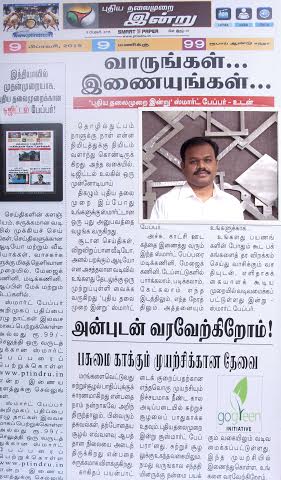
    9th Feb. 2015 ‘PuthiyaThalaimurai digitizes Newspaper

    As a go green initiative New Gen Media launches its Digital Smartpaper ”PuthiyaThalaimuraiIndru.”

    apu
    Chennai based New Gen Media Corporation having proved its mettle in publication, news and entertainment broadcasting is all set to climb the next rung of the ladder – on to the digital platform with the launch of itssmartpaper ”PuthiyaThailaimuraiIndru”on Monday, 9th February 2015 at 9 am.

    apu1
    At the click of the mouse “PT Indru” will reach the Inbox of the subscribers who can access this smart paper with a personalised special code to enjoy the pleasure of reading a virtual print newspaper.

    Speaking on the launch – Mr. R.B.U Shyam Kumar – CEO of New Gen Media Corporation claims ”PuthiyaThalaimuraiIndru is a blue ocean initiative, where we are not competing with any other existing medium. This smart paper is a convergence of print, radio, television and technologyprimarily aimed to cater to the Tamil diaspora across the world.”

    apu2

    a) How it differs from a regular e-paper

    ”PT Indru” is designed like a typical print news paper withadditional advanced features of watching, reading and listening to content. Unlike an e-paper, it will have news in video and audio formats besides another document format for reading which is why it’s being called“a smart paper.”
    Shyam said ”Today we have consumers expecting multiple digital options. After analysing different patterns of news consumption, we have designed ”PT Indru” with smart features catering to all forms of news consumption. Yet another feather to the cap is the eco friendly approach that we have adhered to. We are not using any news print that is made out of felling trees to print the news paper. We can proudly claim that this is a go-green initiative from our socially sensitive group. Yet another added advantage is that the readable news items can be downloaded in PDF format in any gadget for future reading purposes.”

    b) At the Marketing Front

    The pre launch survey, analysis and advertisements of ”PT Indru” have proved that consumers from the age group between 18 to 34 years are keenly interested in the smartpaper. Hitherto, there have been considerable amount of enquiries from the Tamil population living overseas mainly fromUS, UK, Australia, and Canada.

    To quote Mr. Shyam, “I’m expecting a huge response from the Tamil population across the globe, since we are delivering them a virtual Tamil news paper to their gadgets which can be accessed anywhere anytime with utmost convenience which may not be possible with a conventional print news paper. We would like to cater to one lakh subscribers soon. The annual subscription of ”PT Indru” is Rs 99/- which means 30 paise per day.”

    apu3

    c) Why paid Subscription

    In the digital market where free content is widely available, the launch of ”PT Indru” in a paid subscription format is seen as an early attempt by the content provider for monetising the digital content which indeed is a rare phenomenon in today’s world.
    Mr. Shyam justifies their move stating ”we don’t want to encourage anything free…. because, according to us – anything that comes free always has a lesser attention from the consumers. So when they pay, their expectation and concentration on our content will be more and their valuable feedback will trigger us to perform better.Moreover, we are charging a very nominal price of Rs 99 per year, which is just the cost of designing and developing this medium, thereby in the actual sense we are not charging the consumer for content and still. This is indeed much less expensive than the ordinary newspaper” recounts Mr.Shyam.

    d) Advertising opportunities

    There are various advertising options available in ”PT Indru” similar to the print news papers. There will be a Front page premium, Backpage, Right hand page, Banners etc… which will have the special features of linking the brand or advertisers portal with all these advertisements that will redirect the consumers towards their websites.

    e) Brand Positioning

    Upholding the vision of the Group’s President Mr.Sathyanarayanan, ”PT Indru” is being positioned, as a symbol of change in accordance with the changing times. Hence our earnest attempt to replace an ordinary print news paper with our digital smartpaper, more so to cater to the vibrant technologically advanced young generation of smart digital consumers, who are so inclined to their digital life with smartphones, tablets and laptops.

    As a publisher and broadcaster, PuthiyaThalaimurai exhorts the advertisers and consumers “to come along with us to adapt and cater to the changing world of the new generation of consumers – hence our brand name “NewGen Media.”
    f) Editorial

    The editorial affairs of the smartpaper ”PT Indru” will be handled by an efficient team headed by Ms. Jeeva who has moved out of ‘Dinamalar’ publications to join PuthiyaThalaimurai.

    Regarding the editorial Mr. Shyamrecounts ””PT Indruwill have a curated content from our other mediums as a leveraging exercise with inputs from PT’s broadcasting, publications, stingers etc.We will also have special content designed exclusively for the consumers of our smartpaper such as cinema and lighter viewing or reading materials which are not part of our other mediums due to positioning issues.”

    g) Technical Team

    The technical part of ”PT Indru” initiative is sphere headed by Boopi who has a very rich knowledge of digital space. His team is in the process of developing applications for the smart phones which will be rolled out shortly after the launch.
    To put it in a nutshell, New Gen Media Corporation is geared up to pioneer the digital space with the launch of its smartpaper ”PT Indru” which will be followed by a whole range of digital magazines in different genres.
    ***********************

    Share
  • A SONG FOR YOU!

    – K. Ravi

    I weave a song for you
    From my dreams joy and anguish
    You take a form and wear it on – or
    Light the lamp and read the song
    As you wish
    From my dreams joy and anguish
    I weave a song for you

    Like a river it flows from me
    Take a step and drench in it
    Or hold a cup and quench y’r thirst
    As you please
    Like a mountain it rises high
    Climb up and reach the summit
    Or descend like a mist
    As you deem fit

    Like a bird it spreads its wings
    Like the wind it gently swings
    Like the moon it shines bright
    Even at midnight
    From my dreams joy and anguish
    I weave a song for you

    I felt a sudden shivering chill
    I melt and flow with the song
    You smile at me
    Writing the song all along
    You are the singer you write myself
    Just holding my finger
    You weave myself in you
    With rain lightening and thunder
    You weave myself in you
    With rain lightening and thunder
    I just wonder
    I weave a song for you

    https://soundcloud.com/advocatekravi/i-weave-a-song-for-you


    Share
  • உடலும் , மனமும் இணையும் தருணம்!

    பவள சங்கரி

    அமெரிக்காவின் நியூஜெர்சி மாநிலத்தில், கிளப்மெட்ரோ என்ற உடற்பயிற்சி நிலையத்தின் யோகாசனப் பயிற்சியாளர் திருமிகு லிண்டா அவர்களுடன் ஒரு நேர்காணல்!

    DSC00440

    இயந்திரகதியில் ஓடிக்கொண்டிருக்கும் இன்றைய வாழ்க்கை முறையில் மனமும், உடலும் ஒருசேர அமைதி பெற மிக நல்ல உபாயம் யோகாசனம். கிட்டத்தட்ட ஐயாயிரம் ஆண்டுகளுக்கு முன் இந்தியாவில் தோன்றிய உடற்பயிற்சி தியான முறை யோகக் கலை. யோகாசனம் என்பது உடற்பயிற்சி மற்றும் ஆசனங்களைக் குறிப்பது . அனுதினமும் முப்பது நிமிடம் முதல் 1 மணி நேரம் வரை பயிற்சி செய்தால் வெகு விரைவிலேயே நல்ல பலனை அடைய முடியும். தியானம் நம்மை நாமே உணரச் செய்கிறது. மனதை ஒருமுகப்படுத்துவதே தியானம். சாதி, மதம், இனம், மொழி, நாடு, ஆண், பெண் வயது என எந்த வேறுபாடுமின்றி மனதோடு உடலை இணைத்து பயிற்சி செய்வதே யோகம். தியானத்தின் மூலம் பூரண மன அமைதி பெற முடியும். இருதயத்தின் படபடப்பு குறைவதோடு, நினைவாற்றலும் அதிகரிக்கும். அமைதியான, ஆழ்ந்த தூக்கத்தை ஏற்படுத்துவதால் வேலை செய்யும் ஆற்றல் அதிகரிக்கும். இரத்த அழுத்தம், ஆத்துமா போன்ற அனைத்து நோய்களையும் குணப்படுத்த முடிவதோடு ஆயுளும் கூடும். ஏற்கனவே உள்ள நோயின் உபாதைகளை படிப்படியாகக் குறைத்து, அதனை கட்டுக்குள் வைக்க உதவுவதோடு, உடல் ஆரோக்கியம் கூடும். நரம்பு, இரத்த ஓட்டம், ஜீரணம் போன்ற உடலின் மண்டலங்கள் அனைத்தும் சீரடையும் வாய்ப்பு அதிகரிக்கும். இளமையும், நோய் எதிர்ப்பு சக்தியும் கூடும்.

    DSC00417

    5000 ஆண்டுகளுக்கு முன்னரே நம் தமிழ் நாட்டுச் சித்தர்கள் உடல் ஆரோக்கியத்திற்கு வழிவகுக்கும் வகையில் ஆய்ந்தறிந்த அறிவியல் உண்மை யோகாசனம் என்பது.

    DSC00418

    ஓகம் என்று சித்தர்களால் வழங்கப்பட்ட சொல்தான் உயிரும் மெய்யும் கூடும் கலை. இச்சொல்தான் மருவி வடமொழியில் யோகம் என்று அழைக்கப்படுகிறது. உடலும் மெய்யும் ஒன்றாக இருப்பினும் உயிரைத் தனியே நம்மால் உணர முடிவதில்லை. ஆனால் யோகக் கலையை உளப்பூர்வமாக பயிற்சி செய்ய ஆரம்பிக்கும்போது உயிருக்கும் உடலுக்கும் உள்ள தொடர்பை நம்மால் அறிய முடியும் என்பது சித்தர்களின் வாக்கு. அதனால் உயிரையும் உடலையும் பாதுகாக்கும் உத்தியை அறிவதும் எளிதாகிறது . தினமும் காலை மற்றும் மாலையிலும், அல்லது காலையில் மட்டுமாவது இப்பயிற்சியை பழகி வந்தால், நம் உடலோடு உயிரும் புத்துணர்வு பெறுவதை அறியலாம். யோகாசனத்தை முதன்முதலாகப் பழக விரும்புபவர் குறைந்தது ஒரு வார காலமாவது நன்கு பயிற்சி பெற்ற ஒரு குருவிடம் ஒழுங்காகப் பயிற்சி எடுத்துக் கொள்ளுதல் நலம்.

    உலக அளவில் பல நாடுகளில் யோகப்பயிற்சிகள் பரவியுள்ளன. அமெரிக்காவில் யோகாசன வகுப்பில் பயிற்சி பெற பல எதிர்பார்ப்புகளுடன் சென்றபோது சில ஆச்சரியங்களும் காத்திருந்தன. ஆம் ‘ஓம்’ என்ற பிரணவ மந்திரத்துடன் அமைதியான தியானத்தில் ஆரம்பித்து, ‘சிவாய நம’ என்ற திருமந்திரமும் தொடர, சீன யோக மந்திர மெல்லிசை மற்றும் மேலை நாட்டு மிக மெல்லிய மதுர கீதங்களுடன் மிக இனிய அனுபவங்களாக அமைந்திருந்தது லிண்டா அவர்களின் யோகாசன வகுப்பு!

    யோகாசனம் செய்வதற்குரிய பொதுவான நியமனங்கள்:

    yoga

    * பொதுவாக காலை நேரங்களில் ஆசனங்களைப் பழகுவதே சிறந்ததென்றாலும் மாலையில் செய்ய வேண்டிய தேவை வரும்போது, உணவு உண்டு மூன்று மணி நேரத்திற்கு பின்னரே, அதாவது உணவு செரிமானம் ஆன பிறகே யோகப்பயிற்சி செய்தல் வேண்டும். காலையில் எழுந்தவுடன் காபி அல்லது தேநீர் அருந்தும் வழமையுடையவர்களாயின் பானம் அருந்திய அரை மணி நேரத்திற்குப் பின்னரே பயிற்சிகளைச் செய்தல் வேண்டும்.

    * அன்றாடம் ஆசனங்களைச் செய்வதற்கு ஆரம்பிப்பதற்கு முன்பு உடலைத் தயார் நிலைப்படுத்துவதற்காக சில எளிய முன் பயிற்சிகள் செய்தல் வேண்டும்.

    * ஒவ்வொரு முறையும் ஆசனத்தின் முடிவில் இரு முறைகள் மூச்சை நன்றாக இழுத்து விட்டு ஆசுவாசம் கொள்ளல் வேண்டும்.

    * ஆசனங்களைச் செய்யும் போது அது உடலுக்கு எந்தவித சிரமமும் இல்லாமல், தங்களால் இயன்ற அளவிற்கு மிக இலகுவாகச் செய்யும் வண்ணம் இருத்தல் நலம்.

    * அதேபோல ஆசனங்களைச் செய்து முடிக்கும் போது 5 முதல் 10 நிமிடங்கள் வரை சவாசனம் என்ற ஓய்வு ஆசனம் செய்த பிறகே முடிக்க வேண்டும்.

    DSC00435

    * இறுதியாக பிராணாயாமம் என்ற மூச்சுப் பயிற்சி செய்து, 10 முதல் 20 நிமிடங்கள் வரை மனதை ஒருநிலைப்படுத்தி தியானம் செய்வது மேலும் நன்மையளிக்கும்.

    * தினசரி அதிகாலை 4.30 மணி முதல் 6.00 மணிக்குள்ளாக யோகாசனப் பயிற்சி செய்வது சிறந்த பலன் அளிக்கக்கூடியது.

    * யோகாசன பயிற்சியில் தியானம், மூச்சுப்பயற்சி ஆசனம் இந்த மூன்றும் ஒன்றுக்கொன்று தொடர்புள்ளது. ஆகவே, சில நிமிடங்கள் தியானம், பிறகு பிராணாயாமம் , அதன் பிறகு ஆசனங்கள் செய்வது நல்லது. நீர் ஆகாரமாக இருந்தால், அருந்திய பின் அரை மணி நேரம் கழிந்த பின்பும், எளிய சிற்றுண்டியாக இருந்தால் இரண்டு மணி நேரம் கழித்தும், முழுமையான ஆகாரமாக இருந்தால் நான்கு மணி நேரம் கழித்தும் யோகப்பயிற்சிகளை செய்யவும்.

    * யோகப் பயிற்சி முடிந்த பின்பு வியர்வை அடங்கிய பின்னால் தான் குளிக்க வேண்டும்.

    * யோகாசனப் பயிற்சி செய்து முடித்த பின்பு 15 நிமிடங்களுக்குப் பின்னர் ஆகாரம் எடுத்துக்கொள்வது நலம்.

    திருமிகு லிண்டா அவர்களிடம் யோகாசனம் குறித்து கேட்ட செவ்வி மற்றும் அவர் அளித்த விடைகளும் இதோ :

    DSC00439

    1. Could you please tell me why did you choose ‘Yoga’ as your career in particular?

    Linda : I actually chose a career in fitness, which I still love after many years. However, fitness can be rough on the physical body and I became very stiff and sore and decided to try yoga as a means to relieve this. This began my Yoga Journey in 2002. I then enrolled in the American Yoga Academy for my 200 hour teacher training and after that 40 hour training in an Iyengar style and I have been teaching yoga ever since.

    yoga pho

    2. what is the PHILOSOPHY OF YOGA?

    Linda : A simple Philosophy of Yoga is that the Mind, Body and Spirit are all connected.
    Yoga is a collection of spiritual techniques and practices; however, most yoga which is practiced in the West is Hatha Yoga and focuses on movement of the body mostly and eventually clearing the mind thru breath.

    DSC00438

    3. Is yoga a collection of spiritual techniques and practices?

    Linda : Spiritual techniques are usually not included, especially in a gym setting.

    4. About : The Bhagavad Gita, The Upanishads, Vedas – Is there any connectivity with Yoga?

    Linda : Bhagavad Gita, the Upanishads, and Vedas all reference yoga so there is a definite connection between them.

    5. Do we need to Practice Yoga at Home?

    DSC00430

    Linda : Yes, I believe that you should practice yoga at home especially during times of stress or tightness in the body. Those with chronic issues should practice yoga daily if possible. Yoga in general is great for the immune system and overall state of being.

    6. whether there is any yoga practice where one can get relief for chronic diseases?

    Linda : Yoga certainly can provide relief for chronic diseases. Examples are hip openers for sciatica and backbends to stimulate the kidneys.

    7. Sankhya philosophy, one of the oldest and most influential of the six systems (darshans) of Indian thought, has had a profound impact on the beliefs, values and concepts used in… what do you say?

    Linda : Sankhya philosophy – I am not familiar with this philosophy and do not know if there is a connection to yoga.

    8. What is commonly considered Yoga in the West is in actuality just one of the many paths of Yoga, and is technically called Hatha Yoga. The oldest and most widely used ancient text on the physical practices of Hatha Yoga is the Hatha Yoga Pradipika. Do you agree?

    Linda : Yes, the texts of Hatha Yoga Pradipika begin with the physical postures of yoga (Asana) and once strength and flexibility of the body are obtained, thus aiding to rid the body of disease, then breathing techniques begin as a way to bring energy to the body and control the mind and thus release stress (physical and mental stress). From there the Yoga Pradipika can be a guideline to go deeper into Yoga if the participant desires.

    DSC00431

    9. What is Mudra? can you explain about techniques of the Pranayama :-

    Linda : A mudra is like a gesture or a position designed to let energy flow to different areas of the body. It is said that disease is caused by interruption of the flow of energy to the body. The most common mudra is touching the thumb and the index finger. Pranayama is simply breathing and there are many breathing techniques. For example Alternate Nostril Breathing (Nodhi Sodhana) is done to calm the nervous system while Kapalabahti is invigorating. These are breathing exercises in additional to Asana practice. During Asana practice the breath should be full and deep, approximately 6 seconds and used as a way to distract the mind so that you are fully immersed in your Asana practice. During challenging postures, the breath can be used as a means of drawing energy and during relaxing postures, or stretching, the breath can be used as a means of sinking deeper into the posture.

    10. The Hatha Yoga Pradipika gives us a valuable map to these deeper practices of yoga, as well as providing the knowledge and tools to travel to these depths if we so choose. Is it correct?

    Linda : Yes, the Hatha Yoga Pradipika is like a map of yoga which begins with Asana.

    DSC00432

    11. What are the moral, ethical and societal guidelines for practicing yoga?

    Linda : The moral, ethical and societal guidelines for practicing yoga are the “5 Yamas of yoga” which are like rules of behavior: nonviolence, truthfulness, living without excess gluttony, living without unnecessary possessions and non-stealing. Striving for a healthier and more peaceful life.
    Yes, certainly in 2014 we can all use some guidance to live an honest and ethical life and focus less on material possessions and to treat our bodies with respect.

    12. Is yoga helpful for those with Scoliosis?
    (Scoliosis, a condition that leads to lateral curvature of the spine, affects 6 million people in the U.S., from infants to the elderly. The most common age of onset is 10-15 years, and 85 percent of cases are idiopathic.)

    Linda : For those with Scoliosis, especially adolescents, yoga can especially helpful. Side Plank done on only 1 side (the side with the curvature) can help to reduce the curvature without surgery. In severe cases of scoliosis yoga in addition to surgical procedures can be extremely helpful.

    உலகம் முழுவதும் ஒரு கிராமமாக சுருங்கிவிட்ட இந்த காலத்தில், நல்ல விசயங்கள் எங்கு இருந்தாலும், நாடு, இனம், மொழி, மக்கள், மதம் என்ற பேதமில்லாமல் அதை ஏற்றுக்கொண்டு தம் வாழ்வை வளப்படுத்திக்கொள்ளும் பக்குவம் நம் மக்களிடையே வேர்விட ஆரம்பித்துவிட்டதற்கு ‘யோகாசனம்’ என்ற நம் நாட்டுச் சித்தர்களின் அரிய கலை, அமெரிக்காவில் பரவி, அமெரிக்க மக்களிடையே பெரும் நம்பிக்கையை வளர்த்திருப்பதே அதற்கு சான்றாக அமைந்துள்ளது.

    Share
  • Somewhere Ramblings of a Nomadic Soul

    Ajith Subramanian


    What do you desire my soul?
    Happiness? And leave my heart with a hole?
    What is right and what is wrong?
    Happiness personified I am writing this song

    Torn apart as you can see,
    Tell me, how do you define me?
    I am sane is what I think,
    A lifetime just disappears in a wink!

    Oh let me think about time a bit,
    Quantum mechanics and the likes of it,
    What is time? What is space?
    Seems like I run on this recursive race!

    What is truth and what is real?
    Answering that makes my whole world whirl!
    This moment and this second,
    Don’t wanna lose it, I reckon

    Tell me universe or tell me god,
    Am I insane, am I a retard?
    The puzzle of life I try to solve,
    I melt in reality and I just dissolve!

    Happiness and living this moment,
    Is real and that I can see!
    To judge or not to judge,
    Truth and Morality it kills me!

    Who put the rules? And why is it there?
    To live life to the fullest, it’s just fair!
    One life and I know I am the hero,
    Puff! I disappear and I got to start at ground zero!

    Share
  • Manadhil Urudhi Vendum

    AJITH SUBRAMANIAN


    The Original :images (4)

    Manathil uruthi vendum
    Vaakkinile inimai vendum
    Ninaivu nalladhu vendum
    Nerunggina porul kai pada vendum

    Kanavu mei pada vendum
    Kai vasamaavadhu viraivil vendum
    Dhanamum inbamum vendum
    Tharaniyile perumai vendum

    Kan thirandhida vendum
    Kaariyathil uruthi vendum
    Pen viduthalai vendum
    Periya kadavul kaakka vendum

    Mann payanura vendum
    Vaanagam inggu thenpada vendum
    Unmai nindrida vendum


    The Translation :

    A self that remains unflinching with every heart beat,bhara
    A self that can convey the most hurting words soft and sweet,
    A self that can always cherish the noble thought,
    And let the things within my reach always be sought!

    Let each of my dream come true, till the last!
    Let the objects that I hold in my thoughts reach me fast!
    Give me wealth, but also give me infinite happiness on the inside!
    Let the world flourish with abundant pride!

    Oh please open my eyes to understand this world and people too!
    Let there be steadfastness in whatever I do!
    Let there be full liberation of women,
    And let it be that you should always bless us from the heaven!

    Let the land be bountiful,
    And let the sky reflecting the self, be forever beautiful!
    Give me a self that remains calm and clear, no matter what situation I am in!
    Give me a self that remains true to itself, and let truth alone always win!!


    Share
  • All are Invitied for the special Homam on the day of 23rd sep 2014

    ksushmaanda homam on 23rd.september 2014. at danvantri peedam
    Sushmaanda homam for Purattaasi Ammavasai


    image
    A special Sushmaanda homam (Poosanikaai homam) will be held at Sri Danvantri Arogya Peedam, Walajapet, on September 23, 2014, on account of Purattaasi Ammavasai, Peedam founder Kayilai Gnanaguru Dr Sri Muralidhara Swamigal has announced.
    The homam will be performed at 10 a.m., on September 23.
    The performance of homam has not been directly specified in the Vedas, except in the case of Sushmaanda homam. The Yajur vedam specifies Sushmaanda homam. The conduct of homam and the message regarding the other homams had merely been passed on to the devotees by saints from time to time. Sushmaanda homam alone has a specific reference.
    The conduct of Sushmaanda homam will rid one of various doshas including big sins, says Sri Muralidhara Swamigal. Sengalipuram

    Anantharaman Diskshitar had pointed out that performing Sushmaanda homam a day before upanayam or marriage and other such functions would confer benefits. Also, the homam could be done any time a person feels he or she has committed a big sin.
    This homam can be done in a simple way without spending much money. For instance, one or two priests would suffice. The wealthy can spend more money on dhiravyams and other necessities.
    Performance of this homam would rid one of evil effects, enable blessings of parents, prevent indulgence in sinful acts again, and bring about mental peace. In the case of other homams, priests can carry out the functions on behalf of the devotee. In this homam, one has to carry out the homam directly as per the directive of the priest.
    Sri Muralidhara Swamigal has urged devotees to take part in the homam in large numbers on September 23 and derive benefits


    Share
  • My India, My Pride

    My-India-My-Pride

    INDIA

    Contents:
    Introduction
    Geography
    People and Society
    Government
    Economy
    Energy
    Communications
    Transportation
    Military
    Transnational Issues

    Introduction

    Background:
    The Indus Valley civilization, one of the world’s oldest, flourished during the 3rd and 2nd millennia B.C. and extended into northwestern India. Aryan tribes from the northwest infiltrated the Indian subcontinent about 1500 B.C.; their merger with the earlier Dravidian inhabitants created the classical Indian culture. The Maurya Empire of the 4th and 3rd centuries B.C. – which reached its zenith under ASHOKA – united much of South Asia. The Golden Age ushered in by the Gupta dynasty (4th to 6th centuries A.D.) saw a flowering of Indian science, art, and culture. Islam spread across the subcontinent over a period of 700 years. In the 10th and 11th centuries, Turks and Afghans invaded India and established the Delhi Sultanate. In the early 16th century, the Emperor BABUR established the Mughal Dynasty which ruled India for more than three centuries. European explorers began establishing footholds in India during the 16th century. By the 19th century, Great Britain had become the dominant political power on the subcontinent. The British Indian Army played a vital role in both World Wars. Years of nonviolent resistance to British rule, led by Mohandas GANDHI and Jawaharlal NEHRU, eventually resulted in Indian independence, which was granted in 1947. Large-scale communal violence took place before and after the subcontinent partition into two separate states – India and Pakistan. The neighboring nations have fought three wars since independence, the last of which was in 1971 and resulted in East Pakistan becoming the separate nation of Bangladesh. India’s nuclear weapons tests in 1998 emboldened Pakistan to conduct its own tests that same year. In November 2008, terrorists originating from Pakistan conducted a series of coordinated attacks in Mumbai, India’s financial capital. Despite pressing problems such as significant overpopulation, environmental degradation, extensive poverty, and widespread corruption, economic growth following the launch of economic reforms in 1991 and a massive youthful population are driving India’s emergence as a regional and global power.

    Geography

    Location:
    Southern Asia, bordering the Arabian Sea and the Bay of Bengal, between Burma and Pakistan

    Geographic coordinates:
    20 00 N, 77 00 E

    Map references:
    Asia

    Area:
    total: 3,287,263 sq km
    country comparison to the world: 7
    land: 2,973,193 sq km
    water: 314,070 sq km

    Land boundaries:
    total: 13,888 km
    border countries: Bangladesh 4,142 km, Bhutan 659 km, Burma 1,468 km, China 2,659 km, Nepal 1,770 km, Pakistan 3,190 km

    Coastline:
    7,000 km

    Maritime claims:
    territorial sea: 12 nm
    contiguous zone: 24 nm
    exclusive economic zone: 200 nm
    continental shelf: 200 nm or to the edge of the continental margin

    Climate:
    varies from tropical monsoon in south to temperate in north

    Terrain:
    upland plain (Deccan Plateau) in south, flat to rolling plain along the Ganges, deserts in west, Himalayas in north

    Elevation extremes:
    lowest point: Indian Ocean 0 m
    highest point: Kanchenjunga 8,598 m

    Natural resources:
    coal (fourth-largest reserves in the world), iron ore, manganese, mica, bauxite, rare earth elements, titanium ore, chromite, natural gas, diamonds, petroleum, limestone, arable land

    Land use:
    arable land: 47.87%
    permanent crops: 3.74%
    other: 48.39% (2011)

    Irrigated land:
    663,340 sq km (2008)

    Total renewable water resources:
    1,911 cu km (2011)

    Freshwater withdrawal (domestic/industrial/agricultural):
    total: 761 cu km/yr (7%/2%/90%)
    per capita: 613 cu m/yr (2010)

    Natural hazards:
    droughts; flash floods, as well as widespread and destructive flooding from monsoonal rains; severe thunderstorms; earthquakes
    volcanism: Barren Island (elev. 354 m) in the Andaman Sea has been active in recent years

    Environment – current issues:
    deforestation; soil erosion; overgrazing; desertification; air pollution from industrial effluents and vehicle emissions; water pollution from raw sewage and runoff of agricultural pesticides; tap water is not potable throughout the country; huge and growing population is overstraining natural resources

    Environment – international agreements:
    party to: Antarctic-Environmental Protocol, Antarctic-Marine Living Resources, Antarctic Treaty, Biodiversity, Climate Change, Climate Change-Kyoto Protocol, Desertification, Endangered Species, Environmental Modification, Hazardous Wastes, Law of the Sea, Ozone Layer Protection, Ship Pollution, Tropical Timber 83, Tropical Timber 94, Wetlands, Whaling
    signed, but not ratified: none of the selected agreements

    Geography – note:
    dominates South Asian subcontinent; near important Indian Ocean trade routes; Kanchenjunga, third tallest mountain in the world, lies on the border with Nepal

    People and Society

    Nationality:
    noun: Indian(s)
    adjective: Indian

    Ethnic groups:
    Indo-Aryan 72%, Dravidian 25%, Mongoloid and other 3% (2000)

    Languages:
    Hindi 41%, Bengali 8.1%, Telugu 7.2%, Marathi 7%, Tamil 5.9%, Urdu 5%, Gujarati 4.5%, Kannada 3.7%, Malayalam 3.2%, Oriya 3.2%, Punjabi 2.8%, Assamese 1.3%, Maithili 1.2%, other 5.9%

    note: English enjoys the status of subsidiary official language but is the most important language for national, political, and commercial communication; Hindi is the most widely spoken language and primary tongue of 41% of the people; there are 14 other official languages: Bengali, Telugu, Marathi, Tamil, Urdu, Gujarati, Malayalam, Kannada, Oriya, Punjabi, Assamese, Kashmiri, Sindhi, and Sanskrit; Hindustani is a popular variant of Hindi/Urdu spoken widely throughout northern India but is not an official language (2001 census)

    Religions:
    Hindu 80.5%, Muslim 13.4%, Christian 2.3%, Sikh 1.9%, other 1.8%, unspecified 0.1% (2001 census)

    Population:
    1,236,344,631 (July 2014 est.)
    country comparison to the world: 2

    Age structure:
    0-14 years: 28.5% (male 187,016,401/female 165,048,695)
    15-24 years: 18.1% (male 118,696,540/female 105,342,764)
    25-54 years: 40.6% (male 258,202,535/female 243,293,143)
    55-64 years: 7% (male 43,625,668/female 43,175,111)
    65 years and over: 5.7% (male 34,133,175/female 37,810,599) (2014 est.)

    population pyramid:


    https://www.cia.gov/library/publications/the-world-factbook/graphics/population/IN_popgraph%202014.bmp

    Dependency ratios:
    total dependency ratio: 51.8 %
    youth dependency ratio: 43.6 %
    elderly dependency ratio: 8.1 %
    potential support ratio: 12.3 (2014 est.)

    Median age:
    total: 27 years
    male: 26.4 years
    female: 27.7 years (2014 est.)

    Population growth rate:
    1.25% (2014 est.)
    country comparison to the world: 94

    Birth rate:
    19.89 births/1,000 population (2014 est.)
    country comparison to the world: 86

    Death rate:
    7.35 deaths/1,000 population (2014 est.)
    country comparison to the world: 118

    Net migration rate:
    -0.05 migrant(s)/1,000 population (2014 est.)
    country comparison to the world: 112

    Urbanization:
    urban population: 31.3% of total population (2011)
    rate of urbanization: 2.47% annual rate of change (2010-15 est.)

    Major urban areas – population:
    NEW DELHI (capital) 22.654 million; Mumbai 19.744 million; Kolkata 14.402 million; Chennai 8.784 million; Bangalore 8.614 million; Hyderabad 7.837 million (2011)

    Sex ratio:
    at birth: 1.12 male(s)/female
    0-14 years: 1.13 male(s)/female
    15-24 years: 1.13 male(s)/female
    25-54 years: 1.06 male(s)/female
    55-64 years: 1.08 male(s)/female
    65 years and over: 0.91 male(s)/female
    total population: 1.08 male(s)/female (2014 est.)

    Mother’s mean age at first birth:
    19.9 (2005-06 est.)

    Maternal mortality rate:
    200 deaths/100,000 live births (2010)
    country comparison to the world: 55

    Infant mortality rate:
    total: 43.19 deaths/1,000 live births
    country comparison to the world: 50

    male: 41.9 deaths/1,000 live births
    female: 44.63 deaths/1,000 live births (2014 est.)

    Life expectancy at birth:
    total population: 67.8 years
    country comparison to the world: 163

    male: 66.68 years
    female: 69.06 years (2014 est.)

    Total fertility rate:
    2.51 children born/woman (2014 est.)
    country comparison to the world: 81

    Contraceptive prevalence rate:
    54.8% (2007/08)

    Health expenditures:
    3.9% of GDP (2011)
    country comparison to the world: 167

    Physicians density:
    0.65 physicians/1,000 population (2009)

    Hospital bed density:
    0.9 beds/1,000 population (2005)

    Drinking water source:
    improved:
    urban: 96.7% of population
    rural: 90.7% of population
    total: 92.6% of population
    unimproved:
    urban: 3.3% of population
    rural: 9.3% of population
    total: 7.4% of population (2012 est.)

    Sanitation facility access:
    improved:
    urban: 60.2% of population
    rural: 24.7% of population
    total: 36% of population

    unimproved:
    urban: 39.8% of population
    rural: 75.3% of population
    total: 64% of population (2012 est.)

    HIV/AIDS – adult prevalence rate:
    0.3% (2012 est.)
    country comparison to the world: 101

    HIV/AIDS – people living with HIV/AIDS:
    2.085 million (2012 est.)
    country comparison to the world: 3

    HIV/AIDS – deaths:
    135,500 (2012 est.)
    country comparison to the world: 3

    Major infectious diseases:
    degree of risk: very high
    food or waterborne diseases: bacterial diarrhea, hepatitis A and E, and typhoid fever
    vectorborne diseases: dengue fever, Japanese encephalitis, and malaria
    water contact disease: leptospirosis
    animal contact disease: rabies
    note: highly pathogenic H5N1 avian influenza has been identified in this country; it poses a negligible risk with extremely rare cases possible among US citizens who have close contact with birds (2013)

    Obesity – adult prevalence rate:
    1.9% (2008)
    country comparison to the world: 184

    Children under the age of 5 years underweight:
    43.5% (2006)
    country comparison to the world: 2

    Education expenditures:
    3.2% of GDP (2011)
    country comparison to the world: 134

    Literacy:
    definition: age 15 and over can read and write
    total population: 62.8%
    male: 75.2%
    female: 50.8% (2006 est.)

    School life expectancy (primary to tertiary education):
    total: 12 years
    male: 12 years
    female: 11 years (2011)

    Child labor – children ages 5-14:
    total number: 26,965,074
    percentage: 12 % (2006 est.)
    Unemployment, youth ages 15-24:
    total: 10.7%
    country comparison to the world: 107
    male: 10.4%
    female: 11.6% (2012)

    Government

    Country name:
    conventional long form: Republic of India
    conventional short form: India
    local long form: Republic of India/Bharatiya Ganarajya
    local short form: India/Bharat

    Government type:
    federal republic

    Capital:
    name: New Delhi
    geographic coordinates: 28 36 N, 77 12 E
    time difference: UTC+5.5 (10.5 hours ahead of Washington, DC, during Standard Time)

    Administrative divisions:
    29 states and 7 union territories*; Andaman and Nicobar Islands*, Andhra Pradesh, Arunachal Pradesh, Assam, Bihar, Chandigarh*, Chhattisgarh, Dadra and Nagar Haveli*, Daman and Diu*, Delhi*, Goa, Gujarat, Haryana, Himachal Pradesh, Jammu and Kashmir, Jharkhand, Karnataka, Kerala, Lakshadweep*, Madhya Pradesh, Maharashtra, Manipur, Meghalaya, Mizoram, Nagaland, Odisha, Puducherry*, Punjab, Rajasthan, Sikkim, Tamil Nadu, Telangana, Tripura, Uttar Pradesh, Uttarakhand, West Bengal
    note: although its status is that of a union territory, the official name of Delhi is National Capital Territory of Delhi

    Independence:
    15 August 1947 (from the UK)

    National holiday:
    Republic Day, 26 January (1950)

    Constitution:
    previous 1935 (preindependence); latest draft completed 4 November 1949, adopted 26 November 1949, effective 26 January 1950; amended many times, last in 2013 (2013)

    Legal system:
    common law system based on the English model; separate personal law codes apply to Muslims, Christians, and Hindus; judicial review of legislative acts

    International law organization participation:
    accepts compulsory ICJ jurisdiction with reservations; non-party state to the ICCt

    Suffrage:
    18 years of age; universal

    Executive branch:
    chief of state: President Pranab MUKHERJEE (since 22 July 2012);
    Vice President Mohammad Hamid ANSARI (since 11 August 2007)
    head of government: Prime Minister Narendra MODI (since 26 May 2014)
    cabinet: Union Council of Ministers appointed by the president on the recommendation of the prime minister

    elections: president elected by an electoral college consisting of elected members of both houses of Parliament and the legislatures of the states for a five-year term (no term limits); election last held in July 2012 (next to be held in July 2017); vice president elected by both houses of Parliament for a five-year term; election last held in August 2012 (next to be held in August 2017); prime minister chosen by parliamentary members of the majority party following legislative elections
    election results: Pranab MUKHERJEE elected president; percent of vote – Pranab MUKHERJEE 69.31%, Purno SANGMA – 30.69%

    Legislative branch:
    bicameral Parliament or Sansad consists of the Council of States or Rajya Sabha (a body consisting of 245 seats up to 12 of which are appointed by the president, the remainder chosen in staggered elections by the elected members of the state and territorial assemblies; members serve six-year terms) and the People’s Assembly or Lok Sabha (545 seats; 543 members elected by popular vote, 2 appointed by the president; members serve five-year terms)
    elections: People’s Assembly – last held April-May 2014 in 9 phases; (next election must be held by May 2019)
    election results: People’s Assembly – percent of vote by party – NA, ; seats by party – BJP 282, INC 44, AIADMK 37, AITC 34, BJD 20, SS 18, TDP 16, TRS 11, CPI(M) 9, YSRC 9, LJP 6, NCP 6, SP 5, AAP 4, RJD 4, SAD 4, independents 3, other 31

    Judicial branch:
    highest court(s): Supreme Court (the chief justice and 25 associate justices); note – parliament approved an additional 5 judges in 2008
    note – in mid-2011 India’s Cabinet approved the program, National Mission for Justice Delivery and Legal Reform, to eliminate judicial corruption and reduce the backlog of cases
    judge selection and term of office: justices appointed by the president to serve until age 65
    subordinate courts: High Courts; District Courts; Labour Court

    Political parties and leaders:
    Aam Aadmi Party or AAP [Arvind KEJRIWAL]
    All India Anna Dravida Munnetra Kazhagam or AIADMK [J. JAYALALITHAA]
    All India Trinamool Congress or AITC [Mamata BANERJEE]
    Bahujan Samaj Party or BSP [MAYAWATI]
    Bharatiya Janata Party or BJP [Rajnath SINGH]
    Biju Janata Dal or BJD [Naveen PATNAIK]
    Communist Party of India or CPI [Suravaram Sudhakar REDDY, Secretary-General]
    Communist Party of India-Marxist or CPI(M) [Prakash KARAT]
    Dravida Munnetra Kazhagam or DMK [M.KARUNANIDHI]
    Indian National Congress or INC [Sonia GANDHI]
    Janata Dal (United) or JD(U) [Sharad YADAV]
    Lok Janshakti Party (LJP) [Ram Vilas PASWAN]
    Nationalist Congress Party or NCP [Sharad PAWAR]
    Rashtriya Janata Dal or RJD [Lalu Prasad YADAV]
    Rashtriya Lok Dal or RLD [Ajit SINGH]
    Samajwadi Party or SP [Mulayam Singh YADAV]
    Shiromani Akali Dal or SAD [Parkash Singh BADAL]
    Shiv Sena or SS [Uddhav THACKERAY]
    Telugu Desam Party or TDP [Chandrababu NAIDU]
    Telegana Rashtra Samithi (TRS) [K. Chandrashekar RAO]
    YSR Congress(YSRC) [Jaganmohan REDDY]
    note: India has dozens of national and regional political parties

    Political pressure groups and leaders:
    All Parties Hurriyat Conference in the Kashmir Valley (separatist group)
    Bajrang Dal (religious organization)
    India Against Corruption [Anna HAZARE]
    Jamiat Ulema-e Hind (religious organization)
    Rashtriya Swayamsevak Sangh [Mohan BHAGWAT] (nationalist organization)
    Vishwa Hindu Parishad [Ashok SINGHAL] (religious organization)

    other:
    numerous religious or militant/chauvinistic organizations
    hundreds of social reform, anti-corruption, and environmental groups at state and local level
    various separatist groups seeking greater communal and/or regional autonomy

    International organization participation:
    ABEDA, ADB, AfDB (nonregional member), ARF, ASEAN (dialogue partner), BIMSTEC, BIS, BRICS, C, CD, CERN (observer), CICA, CP, EAS, FAO, FATF, G-15, G-20, G-24, G-77, IAEA, IBRD, ICAO, ICC (national committees), ICRM, IDA, IFAD, IFC, IFRCS, IHO, ILO, IMF, IMO, IMSO, Interpol, IOC, IOM, IPU, ISO, ITSO, ITU, ITUC (NGOs), LAS (observer), MIGA, MONUSCO, NAM, OAS (observer), OECD, OPCW, Pacific Alliance (observer), PCA, PIF (partner), SAARC, SACEP, SCO (observer), UN, UNCTAD, UNDOF, UNESCO, UNHCR, UNIDO, UNIFIL, UNISFA, UNITAR, UNMISS, UNOCI, UNSC (temporary), UNWTO, UPU, WCO, WFTU (NGOs), WHO, WIPO, WMO, WTO

    Diplomatic representation in the US:
    chief of mission: Ambassador Subrahmanyam JAISHANKAR (since 10 March 2014)

    Flag description:
    three equal horizontal bands of saffron (subdued orange) (top), white, and green, with a blue chakra (24-spoked wheel) centered in the white band; saffron represents courage, sacrifice, and the spirit of renunciation; white signifies purity and truth; green stands for faith and fertility; the blue chakra symbolizes the wheel of life in movement and death in stagnation

    National symbol(s):
    the Lion Capital of Ashoka, which depicts four Asiatic lions standing back to back mounted on a circular abacus, is the official emblem; the Bengal tiger is the national animal; the lotus is the national flower

    National anthem:
    name: “Jana-Gana-Mana” (Thou Art the Ruler of the Minds of All People)
    lyrics/music: Rabindranath TAGORE
    note: adopted 1950; Rabindranath TAGORE, a Nobel laureate, also wrote Bangladesh’s national anthem

    Economy

    Economy – overview:
    India is developing into an open-market economy, yet traces of its past autarkic policies remain. Economic liberalization measures, including industrial deregulation, privatization of state-owned enterprises, and reduced controls on foreign trade and investment, began in the early 1990s and served to accelerate the country’s growth, which averaged under 7% per year from 1997 to 2011. India’s diverse economy encompasses traditional village farming, modern agriculture, handicrafts, a wide range of modern industries, and a multitude of services. Slightly less than half of the work force is in agriculture, but, services are the major source of economic growth, accounting for nearly two-thirds of India’s output with less than one-third of its labor force. India has capitalized on its large educated English-speaking population to become a major exporter of information technology services, business outsourcing services, and software workers. India’s economic growth began slowing in 2011 because of a decline in investment, caused by high interest rates, rising inflation, and investor pessimism about the government’s commitment to further economic reforms and about the global situation. In late 2012, the Indian Government announced additional reforms and deficit reduction measures, including allowing higher levels of foreign participation in direct investment in the economy. The outlook for India’s long-term growth is moderately positive due to a young population and corresponding low dependency ratio, healthy savings and investment rates, and increasing integration into the global economy. However, India has many challenges that it has yet to fully address, including poverty, corruption, violence and discrimination against women and girls, an inefficient power generation and distribution system, ineffective enforcement of intellectual property rights, decades-long civil litigation dockets, inadequate transport and agricultural infrastructure, limited non-agricultural employment opportunities, high spending and poorly-targeted subsidies, inadequate availability of quality basic and higher education, and accommodating rural-to-urban migration. Growth in 2013 fell to a decade low, as India’s economic leaders struggled to improve the country’s wide fiscal and current account deficits. Rising macroeconomic imbalances in India and improving economic conditions in Western countries, led investors to shift capital away from India, prompting a sharp depreciation of the rupee. However, investors’ perceptions of India improved in early 2014, due to a reduction of the current account deficit and expectations of post-election economic reform, resulting in a surge of inbound capital flows and stabilization of the rupee.

    GDP (purchasing power parity):
    $4.99 trillion (2013 est.)
    country comparison to the world: 4
    $4.833 trillion (2012 est.)
    $4.63 trillion (2011 est.)
    note: data are in 2013 US dollars

    GDP (official exchange rate):
    $1.67 trillion (2013 est.)

    GDP – real growth rate:
    3.2% (2013 est.)
    country comparison to the world: 108
    5.1% (2012 est.)
    7.5% (2011 est.)

    GDP – per capita (PPP):
    $4,000 (2013 est.)
    country comparison to the world: 169
    $3,900 (2012 est.)
    $3,800 (2011 est.)
    note: data are in 2013 US dollars

    Gross national saving:
    33.7% of GDP (2013 est.)
    country comparison to the world: 16
    28.8% of GDP (2012 est.)
    30.3% of GDP (2011 est.)

    GDP – composition, by end use:
    household consumption: 56.4%
    government consumption: 12.4%
    investment in fixed capital: 29.6%
    investment in inventories: 8.2%
    exports of goods and services: 25.2%
    imports of goods and services: -31.8%
    (2013 est.)

    GDP – composition, by sector of origin:
    agriculture: 17.4%
    industry: 25.8%
    services: 56.9% (2013 est.)

    Agriculture – products:
    rice, wheat, oilseed, cotton, jute, tea, sugarcane, lentils, onions, potatoes; dairy products, sheep, goats, poultry; fish

    Industries:
    textiles, chemicals, food processing, steel, transportation equipment, cement, mining, petroleum, machinery, software, pharmaceuticals

    Industrial production growth rate:
    0.9% (2013 est.)
    country comparison to the world: 152

    Labor force:
    487.3 million (2013 est.)
    country comparison to the world: 2

    Labor force – by occupation:
    agriculture: 49%
    industry: 20%
    services: 31% (2012 est.)

    Unemployment rate:
    8.8% (2013 est.)
    country comparison to the world: 98
    8.5% (2012 est.)

    Population below poverty line:
    29.8% (2010 est.)

    Household income or consumption by percentage share:
    lowest 10%: 3.6%
    highest 10%: 31.1% (2005)

    Distribution of family income – Gini index:
    36.8 (2004)
    country comparison to the world: 80
    37.8 (1997)

    Budget:
    revenues: $181.3 billion
    expenditures: $281.6 billion (2013 est.)

    Taxes and other revenues:
    10.3% of GDP (2013 est.)
    country comparison to the world: 208

    Budget surplus (+) or deficit (-):
    -5.7% of GDP (2013 est.)
    country comparison to the world: 175

    Public debt:
    51.8% of GDP (2013 est.)
    country comparison to the world: 63
    51.7% of GDP (2012 est.)
    note: data cover central government debt, and exclude debt instruments issued (or owned) by government entities other than the treasury; the data include treasury debt held by foreign entities; the data exclude debt issued by subnational entities, as well as intra-governmental debt; intra-governmental debt consists of treasury borrowings from surpluses in the social funds, such as for retirement, medical care, and unemployment; debt instruments for the social funds are not sold at public auctions

    Fiscal year:
    1 April – 31 March

    Inflation rate (consumer prices):
    9.6% (2013 est.)
    country comparison to the world: 208
    9.7% (2012 est.)

    Central bank discount rate:
    7.75% (31 December 2013 est.)
    country comparison to the world: 34
    8% (31 December 2010 est.)
    note: this is the Indian central bank’s policy rate – the repurchase rate

    Commercial bank prime lending rate:
    10.6% (31 December 2013 est.)
    country comparison to the world: 76
    10.63% (31 December 2012 est.)

    Stock of narrow money:
    $303.1 billion (31 December 2013 est.)
    country comparison to the world: 16
    $317.4 billion (31 December 2012 est.)

    Stock of broad money:
    $1.376 trillion (31 December 2013 est.)
    country comparison to the world: 13
    $1.396 trillion (31 December 2012 est.)

    Stock of domestic credit:
    $1.379 trillion (31 December 2013 est.)
    country comparison to the world: 15
    $1.401 trillion (31 December 2012 est.)

    Market value of publicly traded shares:
    $1.263 trillion (31 December 2012 est.)
    country comparison to the world: 13
    $1.015 trillion (31 December 2011)
    $1.616 trillion (31 December 2010 est.)

    Current account balance:
    -$74.79 billion (2013 est.)
    country comparison to the world: 190
    -$91.47 billion (2012 est.)

    Exports:
    $313.2 billion (2013 est.)
    country comparison to the world: 19
    $296.8 billion (2012 est.)

    Exports – commodities:
    petroleum products, precious stones, machinery, iron and steel, chemicals, vehicles, apparel

    Exports – partners:
    UAE 12.3%, US 12.2%, China 5%, Singapore 4.9%, Hong Kong 4.1% (2012)

    Imports:
    $467.5 billion (2013 est.)
    country comparison to the world: 12
    $488.9 billion (2012 est.)

    Imports – commodities:
    crude oil, precious stones, machinery, fertilizer, iron and steel, chemicals

    Imports – partners:
    China 10.7%, UAE 7.8%, Saudi Arabia 6.8%, Switzerland 6.2%, US 5.1% (2012)

    Reserves of foreign exchange and gold:
    $295 billion (31 December 2013 est.)
    country comparison to the world: 11
    $296 billion (28 December 2012 est.)

    Debt – external:
    $412.2 billion (31 December 2013 est.)
    country comparison to the world: 29
    $378.9 billion (31 December 2012 est.)

    Stock of direct foreign investment – at home:
    $310 billion (30 November 2013 est.)
    country comparison to the world: 20
    $225.1 billion (31 December 2012 est.)

    Stock of direct foreign investment – abroad:
    $120.1 billion (31 December 2013 est.)
    country comparison to the world: 28
    $118.1 billion (31 December 2012 est.)

    Exchange rates:
    Indian rupees (INR) per US dollar –
    58.68 (2013 est.)
    53.437 (2012 est.)
    45.726 (2010 est.)
    48.405 (2009)
    43.319 (2008)

    Energy

    Electricity – production:
    871 billion kWh (FY11/12 est.)
    country comparison to the world: 6

    Electricity – consumption:
    698.8 billion kWh (2010 est.)
    country comparison to the world: 6

    Electricity – exports:
    62 million kWh (2011 est.)
    country comparison to the world: 81

    Electricity – imports:
    5.7 billion kWh (2011 est.)
    country comparison to the world: 36

    Electricity – installed generating capacity:
    199.9 million kW (31 March 2012 est)
    country comparison to the world: 6

    Electricity – from fossil fuels:
    65.8% of total installed capacity (31 March 2012 est)
    country comparison to the world: 118

    Electricity – from nuclear fuels:
    2.4% of total installed capacity (31 March 2012 est)
    country comparison to the world: 25

    Electricity – from hydroelectric plants:
    19.5% of total installed capacity (31 March 2012 est)
    country comparison to the world: 91

    Electricity – from other renewable sources:
    12.3% of total installed capacity (31 March 2012 est)
    country comparison to the world: 21

    Crude oil – production:
    990,200 bbl/day (2012 est.)
    country comparison to the world: 21

    Crude oil – exports:
    0 bbl/day (2010 est.)
    country comparison to the world: 130

    Crude oil – imports:
    3.272 million bbl/day (2010 est.)
    country comparison to the world: 4

    Crude oil – proved reserves:
    5.476 billion bbl (1 January 2013 est.)
    country comparison to the world: 23

    Refined petroleum products – production:
    4.216 million bbl/day (2010 est.)
    country comparison to the world: 5

    Refined petroleum products – consumption:
    3.292 million bbl/day (2011 est.)
    country comparison to the world: 5

    Refined petroleum products – exports:
    1.247 million bbl/day (2010 est.)
    country comparison to the world: 6

    Refined petroleum products – imports:
    379,600 bbl/day (2010 est.)
    country comparison to the world: 16

    Natural gas – production:
    40.38 billion cu m (2012 est.)
    country comparison to the world: 22

    Natural gas – consumption:
    64.49 billion cu m (2010 est.)
    country comparison to the world: 11

    Natural gas – exports:
    0 cu m (2011 est.)
    country comparison to the world: 119

    Natural gas – imports:
    16.39 billion cu m (2011 est.)
    country comparison to the world: 23

    Natural gas – proved reserves:
    1.241 trillion cu m (1 January 2013 est.)
    country comparison to the world: 23

    Carbon dioxide emissions from consumption of energy:
    1.726 billion Mt (2011 est.)

    Communications

    Telephones – main lines in use:
    31.08 million (2012)
    country comparison to the world: 10

    Telephones – mobile cellular:
    893.862 million (2013)
    country comparison to the world: 2

    Telephone system:
    general assessment: supported by recent deregulation and liberalization of telecommunications laws and policies, India has emerged as one of the fastest growing telecom markets in the world; total telephone subscribership base exceeded 900 million in 2011, an overall teledensity of roughly 75%, and subscribership is currently growing more than 20 million per month; urban teledensity now exceeds 100% and rural teledensity is steadily growing

    domestic: mobile cellular service introduced in 1994 and organized nationwide into four metropolitan areas and 19 telecom circles each with multiple private service providers and one or more state-owned service providers; in recent years significant trunk capacity added in the form of fiber-optic cable and one of the world’s largest domestic satellite systems, the Indian National Satellite system (INSAT), with 6 satellites supporting 33,000 very small aperture terminals (VSAT)

    international: country code – 91; a number of major international submarine cable systems, including Sea-Me-We-3 with landing sites at Cochin and Mumbai (Bombay), Sea-Me-We-4 with a landing site at Chennai, Fiber-Optic Link Around the Globe (FLAG) with a landing site at Mumbai (Bombay), South Africa – Far East (SAFE) with a landing site at Cochin, the i2i cable network linking to Singapore with landing sites at Mumbai (Bombay) and Chennai (Madras), and Tata Indicom linking Singapore and Chennai (Madras), provide a significant increase in the bandwidth available for both voice and data traffic; satellite earth stations – 8 Intelsat (Indian Ocean) and 1 Inmarsat (Indian Ocean region); 9 gateway exchanges operating from Mumbai (Bombay), New Delhi, Kolkata (Calcutta), Chennai (Madras), Jalandhar, Kanpur, Gandhinagar, Hyderabad, and Ernakulam (2011)

    Broadcast media:
    Doordarshan, India’s public TV network, operates about 20 national, regional, and local services; a large and increasing number of privately owned TV stations are distributed by cable and satellite service providers; by 2011, more than 100 million homes had access to cable and satellite TV offering more than 700 TV channels; government controls AM radio with All India Radio operating domestic and external networks; news broadcasts via radio are limited to the All India Radio Network; since 2000, privately-owned FM stations have been permitted and their numbers have increased rapidly (2007)

    Internet country code:
    .in

    Internet hosts:
    6.746 million (2012)
    country comparison to the world: 17

    Internet users:
    61.338 million (2009)
    country comparison to the world: 6

    Transportation

    Airports:
    346 (2013)
    country comparison to the world: 21

    Airports – with paved runways:
    total: 253
    over 3,047 m: 22
    2,438 to 3,047 m: 59
    1,524 to 2,437 m: 76
    914 to 1,523 m: 82
    under 914 m: 14 (2013)

    Airports – with unpaved runways:
    total: 93
    over 3,047 m: 1
    2,438 to 3,047 m: 3
    1,524 to 2,437 m: 6
    914 to 1,523 m: 38
    under 914 m:
    45 (2013)

    Heliports:
    45 (2013)

    Pipelines:
    condensate/gas 9 km; gas 13,581 km; liquid petroleum gas 2,054 km; oil 8,943 km; oil/gas/water 20 km; refined products 11,069 km (2013)

    Railways:
    total: 63,974 km
    country comparison to the world: 4
    broad gauge: 54,257 km 1.676-m gauge (18,927 km electrified)
    narrow gauge: 7,180 km 1.000-m gauge; 2,537 km 0.762-m gauge and 0.610-m gauge (2009)

    Roadways:
    total: 4,689,842 km
    country comparison to the world: 2
    note: includes 79,116 km of national highways and expressways, 155,716 km of state highways, and 4,455,010 km of other roads (2013)

    Waterways:
    14,500 km (5,200 km on major rivers and 485 km on canals suitable for mechanized vessels) (2012)
    country comparison to the world: 9

    Merchant marine:
    total: 340
    country comparison to the world: 29

    by type: bulk carrier 104, cargo 78, chemical tanker 22, container 14, liquefied gas 11, passenger 4, passenger/cargo 15, petroleum tanker 92
    foreign-owned: 10 (China 1, Hong Kong 2, Jersey 2, Malaysia 1, UAE 4)
    registered in other countries: 76 (Cyprus 4, Dominica 2, Liberia 8, Malta 3, Marshall Islands 10, Nigeria 1, Panama 24, Saint Kitts and Nevis 2, Singapore 21, unknown 1) (2010)

    Ports and terminals:
    major seaport(s): Chennai, Jawaharal Nehru Port, Kandla, Kolkata (Calcutta), Mumbai (Bombay), Sikka, Vishakhapatnam
    container port(s) (TEUs): Chennai (1,558,343), Jawaharal Nehru Port (4,307,622)

    Military

    Military branches:
    Army; Navy (includes naval air arm); Air Force; Coast Guard (2011)

    Military service age and obligation:
    16-18 years of age for voluntary military service (Army 17 1/2, Air Force 17, Navy 16 1/2); no conscription; women may join as officers, but for noncombat roles only (2012)

    Manpower available for military service:
    males age 16-49: 319,129,420
    females age 16-49: 296,071,637 (2010 est.)

    Manpower fit for military service:
    males age 16-49: 249,531,562
    females age 16-49: 240,039,958 (2010 est.)

    Manpower reaching militarily significant age annually:
    male: 12,151,065
    female: 10,745,891 (2010 est.)

    Military expenditures:
    2.43% of GDP (2012)
    country comparison to the world: 31
    2.58% of GDP (2011)
    2.43% of GDP (2010)

    Transnational Issues

    Disputes – international:
    since China and India launched a security and foreign policy dialogue in 2005, consolidated discussions related to the dispute over most of their rugged, militarized boundary, regional nuclear proliferation, Indian claims that China transferred missiles to Pakistan, and other matters continue; Kashmir remains the site of the world’s largest and most militarized territorial dispute with portions under the de facto administration of China (Aksai Chin), India (Jammu and Kashmir), and Pakistan (Azad Kashmir and Northern Areas); India and Pakistan resumed bilateral dialogue in February 2011 after a two-year hiatus, have maintained the 2003 cease-fire in Kashmir, and continue to have disputes over water sharing of the Indus River and its tributaries; UN Military Observer Group in India and Pakistan has maintained a small group of peacekeepers since 1949; India does not recognize Pakistan’s ceding historic Kashmir lands to China in 1964; to defuse tensions and prepare for discussions on a maritime boundary, India and Pakistan seek technical resolution of the disputed boundary in Sir Creek estuary at the mouth of the Rann of Kutch in the Arabian Sea; Pakistani maps continue to show its Junagadh claim in Indian Gujarat State; Prime Minister Singh’s September 2011 visit to Bangladesh resulted in the signing of a Protocol to the 1974 Land Boundary Agreement between India and Bangladesh, which had called for the settlement of longstanding boundary disputes over undemarcated areas and the exchange of territorial enclaves, but which had never been implemented; Bangladesh referred its maritime boundary claims with Burma and India to the International Tribunal on the Law of the Sea; Joint Border Committee with Nepal continues to examine contested boundary sections, including the 400 sq km dispute over the source of the Kalapani River; India maintains a strict border regime to keep out Maoist insurgents and control illegal cross-border activities from Nepal

    Refugees and internally displaced persons:
    refugees (country of origin): 100,003 (Tibet/China); 65,674 (Sri Lanka); 11,122 (Burma); 10,328 (Afghanistan) (2013)
    IDPs: at least 531,000 (about 250,000 are Kashmiri Pandits from Jammu and Kashmir) (2014)

    Illicit drugs:
    world’s largest producer of licit opium for the pharmaceutical trade, but an undetermined quantity of opium is diverted to illicit international drug markets; transit point for illicit narcotics produced in neighboring countries and throughout Southwest Asia; illicit producer of methaqualone; vulnerable to narcotics money laundering through the hawala system; licit ketamine and precursor production

    Source:
    The Central Intelligence Agency of the United States of America
    https://www.cia.gov/library/publications/the-world-factbook/geos/in.html
    Copyright: Public Domain
    [PAGE LAST UPDATED ON JUNE 22, 2014]

    Share