Category: Articles

  • What a big heart it is?

    What a big heart it is?

    Baskar Seshadri

    Sevalaya is now a household name which has been functioning for almost three decades extending the best of their social services with the best support that pours from various sources like individuals and corporate companies. It was started with just five kids in a rented home in chennai and now it has service facility that is being extended in other parts of Tamilnadu like Trichy, Thiruvallur and Kancheepuram. It is headed by Sri V Muralidaran with the able support from other office bearers/trustees and all these years they have been functioning on PS Sivaswamy Salai near Vivekananda college.

    Mr. V. Muralidharan, Founder and Managing trustee of Sevalaya

    Now the news is more Big. Mrs. Lakshmi Venkatraman a old resident of Mylapore who was so impressed with the service of Sevalaya had come forward to donate a flat belonging to her on Ananda Road near Abiramapuram. Its not just a donation but it was a real transfer of the deed of the property on the name of Sevalaya.

    A 1250 Square feet residential home is now being converted as an office and the service organization is to move there soon. The estimated value of the property in today’s realty market value is close to 1.75 Crores. What a big heart Mam to donate for such a lovely cause?

    Mrs. Lakshmi is quiet about all these media reports and she want to stay away from all the lauding reports. She is a writer who has been contributing since late eighties in Arts and Culture section of The Hindu and a critic too. When I approached her over phone for a small appointment she was too hesitant to speak on the said subject but I insisted her that she speak to me for a minute on the said cause. I literally fell at her feet and said it was greatest Generosity I had come across in the recent times. My Pranams Madam.

    She is the granddaughter of Late Justice Sundaram on whose name there is a road now near Nageswara rao park and Rama Rao road. One of the Greatest Moments in my life which had melted me on a public cause recently.

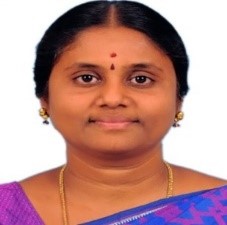
    Cover Photo: Mrs. Lakshmi Venkatraman

    Share
  • Online Teaching and Learning – Problems and Solutions

    Online Teaching and Learning – Problems and Solutions

    V. Tamilselvi
    Assistant Professor
    Department of Business Administration
    Parvathy’s Arts and Science College, Dinigul

    Introduction

    Online learning is education that takes place over the Internet. It is often referred to as “e- learning” among other terms. However, online learning is just one type of “distance learning” – the umbrella term for any learning that takes place across distance and not in a traditional classroom.

    Online learning is catalyzing a pedagogical shift in how we teach and learn. There is a shift away from top-down lecturing and passive students to a more interactive, collaborative approach in which students and instructor co-create the learning process. The Instructor’s role is changing from the “sage on the stage” to “the guide on the side.” Main advantages of online learning

    Convenience

    24/7 access from any online computer; accommodates busy schedules; no commuting, no searching for parking.

    Enhanced Learning

    Increased depth of understanding and retention of course content; more meaningful discussions; emphasis on writing skills, technology skills, and life skills like time management, independence, and self-discipline.

    Leveling of the Playing Field

    Students can take more time to think and reflect before communicating; shy students tend to thrive online; anonymity of the online environment.

    Interaction

    Increased student-to-teacher and student-to-student interaction and discussion;a more student-centered learning environment; less passive listening and more activelearning; a greater sense of connectedness, synergy.

    Innovative Teaching

    Student-centered approaches; increased variety and creativity of learning activities; address different learning styles; changes and improvements can translate to on-ground courses as well

    Improved Administration

    Time to examine student work more thoroughly;  ability to document and record online interactions; ability to manage grading online.

    Savings

    Accommodate more students; increased student satisfaction = higher retention and fewer repeats.

    Maximize Physical Resources

    Lessen demand on limited campus infrastructure; decrease congestion on campus and parking lots.

    Outreach

    Give students options; reach new student markets; appeal to current students  thus increasing enrollments.

    Online Learning Challenges Faced by Students

    1. Adaptability

    Students find it difficult to adapt to an online learning environment immediately after traditional classroom learning. Due to the sudden change, they are not able to adapt to the commuter based learning. Students who have been always studying in the traditional classroom mindset are not able to focus on online platforms. It is important for them to accept the new learning environment with an open mind.

    2. Technical Issues

    Many students are not well equipped with a high internet connection that is required for online learning. Due to this, they face problems in going live for virtual learning and other platforms that require internet connection. They face technical issues as they are not much aware of technology and computer applications. A slow and high internet connection can play an important role in how quickly you can attend the class and do not miss any live sessions. There is a possibility of poor connectivity if you find difficulty in downloading some information related to the subject, blurred videos, etc.

    You just need to find a high-speed internet connection at your home. And know where you can get technical support for your connection and other technical issues related to software and tools for effective learning.

    3. Computer Knowledge

    Lack of computer education is a major concern in today’s world. There are many students who still cannot operate basic computers with MS word and PowerPoint. And whenever some technical issues emerge, they find it difficult to solve the problem in such a scenario. They face difficulties with live classes, usage of appropriate icons, MS office, communication-related apps and websites, browsing study materials, etc. Sometimes they do not know technology proficiency like login, live classes, creating and submitting work, communicating with teachers and friends.

    4. Time Management

    In many cases students find difficulty in managing their time with online learning. Online learning is completely new for them and requires intensive work. They need a scheduled planner to manage their time in an effective manner. Online learning provides flexible time unlike traditional classrooms. But some face difficulties in adjusting to the time required for online learning.
    5. Self Motivation

    Students start losing hope once they find difficulty in online learning. It requires motivation to complete tasks and engage students with their learning. Lack of motivation is a common challenge for all students.

    6 . Distraction

    Learning from home is an amazing experience. You might expect things around you to be like a school campus. But at home things are different for example, you might want a massive classroom, parks, playgrounds, canteens, friends, teachers around you to guide and learn. But with online learning, you have to manage everything in one room with parents around you. You can be easily distracted by small things at home.

    7 . Learning Styles

    Most of the students have learned in the physical classroom. Online learning can make you adapt to different styles of learning. There are some students who can adapt to these styles quickly but what about the students who need time? In such cases, they lack concentration, inability to understand the live classes, difficulty in creating projects and assignments using technology.

    8. Communication

    Students lack effective communication skills during online learning. Teachers give assignments for improving reading and writing skills but there is a possibility that they might not be able to write so convincingly that educators understand the concept behind their assignments.

    There are some students who feel shy to communicate with their teachers and friends due to the new model of learning. It might happen due to lack of interest, poor technological skills with apps and video calls or unable to express themselves via live chats, emails or text messages.

    9. Virtual Engagement

    Online classes help teachers to provide reading material, assignments, communication via email, live chats or messages and delivering content by live sessions, presentations, recorded videos or lectures for the students.

    In spite of all these activities, still some students do not find engaging compared to a traditional one. Students find it difficult to communicate in person who struggles with understanding concepts. Many times these students do not even approach teachers to clear their doubts.

    10. Feedback

    Every student needs feedback for their performance during the learning process so that they can improve their learning abilities. They are not only observed during the tests or exams but also for each assignment and project. Research reveals that the students hardly visit their assignments to check their suggestions and comments. The feedback model with respect to online will be difficult for them to understand and implement.

    Solutions for the on line Learning

    Nowadays adaptive learning is using Artificial intelligence to adjust the content according to individual needs. It helps in providing personalised courses to identify their weaknesses and strengths for better learning outcomes.

    Need to find a high-speed internet connection at your home. And know where you can get technical support for your connection and other technical issues related to software and tools for effective learning.

    Students should be provided access to support devices that can help them solve technical problems via call, email or live chat. You should pay attention to your instructor during the process of solving the issues.

    Time management is the most important factor in online learning. It needs time and effort for better learning outcomes. You should know the factors that can affect your timings during the learning process such as

    A) Avoid Distractions – Try to avoid distractions that can affect your learning. There are many platforms that can engage you for entertainment and communication. But make sure that you set time for breaks and focus on learning as scheduled to avoid missing live classes or sessions.

    B) Create To-Do List – You can prepare a list of activities on an everyday basis. Try to break down large activities into smaller ones for better learning outcomes. Use this list to tackle each task. Make sure that you adhere to the list and establish the routine that can make time management practices easy.

    C) Seek Help – To manage time during online learning seek help from your parents, friends and families. So that you will not miss out on learning and at the same time work will be done.

    D) Avoid Multitasking – Do not try to take up multiple tasks at the same time. Complete one task at a time as it can make your work less effective and productive

    E) Involve Yourself – You should show up for all the activities and learning during the sessions. Make sure that you log in every day, check for the status and appear in all the sessions and discussions. Connect with your friends and teachers for asking and sharing information.

    F) Schedule Time for Learning – You have to stick to a study plan for effective learning. Take a break and resume back to learning with the same interest and enthusiasm.

    G) Stay Positive – Make sure that you are positive towards online learning. Make use of the time in the best way and gain knowledge for better learning outcomes.

    Inform the parents and friends about the time of online learning so that there will be no distractions from their side. Restrict the study area for others to come during live sessions and video calls. Make sure you relax in the breaks set in the time table. In this way, you will concentrate on learning and spend quality time with your friends and family.

    To get better learning outcomes, it is important to understand the learning styles. You can learn through interaction, visual presentations, audio classes or written notes. Follow your own learning style that helps in enhancing your learning experience.

    Become aware of the importance of communication for better learning. Online learning enhances your learning experience. It provides a platform for communication and interaction with others. In this way, you are able to learn from them and improve their knowledge and skills. If you have any issues in communication, then seek help from teachers and friends. Ask them tools that can help you improve your communication skills. You read, write and interact for better communication.

    Communicate with your teachers in private to clear doubts either through virtual learning platforms or calls. Your teachers might be able to help you out more clearly. And they can help you with some of the easy reading materials that are simple to understand. You can also take extra time with your teachers and friends after the online classes for a better understanding of the subject.

    You can approach your teachers for feedback related to your performance. Teachers can give your personalized guidance for improvement and identify your weaknesses and strengths. You can improve your learning pattern based on the feedback. Unless you receive feedback from teachers, there are chances of less improvement in your learning.

    Online Learning Challenges Faced by Teachers

    As education is going on online, many educators are being asked to teach their students from home. We know that all the teachers are not aware of online learning and their process as most of them are into traditional classroom teaching. It sometimes makes it difficult for them to change their way of teaching. Proper online training should be given to teachers before teaching students. With all the benefits of online learning still there are few challenges faced by teachers.

    There is a saying for every problem, there is a solution. So let us not only see the challenges but also find solutions to overcome them. Here are 10 challenges for teachers faced during the online learning process along with ways to overcome them

    1. Engaging students

    As students are moving towards online learning from traditional classrooms, it becomes difficult for teachers to adjust to a new learning platform. Teaching online may not influence and engage students for longer periods of time. They can easily get distracted and lose concentration during live sessions.

    Solution

    You need to understand that online learning has a lot of advantages with respect to tools and interesting platforms to engage students in learning. Try to include those tools and multiple types of learning approaches such as podcasts, videos ( teaching channel, own videos, live classes), discussions, various forms of text through articles and blogs, different assessment methods (tests, quizzes, assignments and projects) learning activities and collaboration for better learning outcomes.

    2. Time Commitment

    If the course content is thought in person then you might not really understand the time commitment. It is still difficult to convert those learning into effective online format. Teachers should be given some time for proper planning of the content and methods to deliver to the students. Teachers are not able to deliver the effective content in time. It said that teachers take more time in teaching online than face to face. If students exceed their deadline in submitting assignments or projects can lead to more work for you.

    Solution

    Use a friendly tone for communicating with your students to establish rapport. You can set reminders for assignments and projects in your learning management system. Send it to your students one week prior to the submission deadline

    3. Communication

    The more detailed the syllabus, the easier to communicate to the students. Sometimes teachers are not given enough time for the preparation of content for their students. And also there are students who avoid communication with teachers during online learning.

    Online teaching is like communicating without body language, so students might misunderstand and can result in their poor performance. Sometimes students might ask for an extension for their work or give any excuse for the delay

    Solution

    Give flexibility for the students when they ask for not making up to their deadlines. You must recognize the need of keeping in contact with the students and understand what kind of activities can accomplish your goal. Conduct discussions for specific content for the students with the opportunity to solve the problem and learning effectively.

     Also providing discussion on practical questions by the students that can reduce frustration, problem-solving skills and handling technical issues. You should provide a platform for the students in order to communicate and collaborate with other fellow classmates.

    4. Assessment

    Assessment is the most important part of online learning for students as well as teachers. And it causes stress to students at times. So whenever there are assignments or projects, teachers might face a lot of questions from the students. As there is less communication between students and teachers, expectation from the students’ performances also differs. Students are likely to experience less homework, less assignments or lack of examination at times. This can cause difficulties for teachers in assessments.

    Solution

    You must understand the type of questions students might ask and prepare FAQs for the common questions. Make sure that you give proper assignments and conduct tests at regular intervals. This can help you to assess them based on their performance.

    5. Feedback

    Every student needs feedback for their performance for improvement. Teachers find it difficult to give feedback to all students individually. Sometimes few students get benefited from it and others don’t. As students are not given proper feedback leading to poor performance. Teachers do not find proper methods of providing feedback to all the students.

    Solution

    You should understand how important it is to give feedback for the students for their growth and improvement. Make sure that you provide personalized guidance to all the students so that they can work on their learning abilities.

    6. Learning Management Systems

    Teachers experience a hard time in expressing their content to students, especially assignments and assessments. There have been problems with understanding the level of difficulty in terms of course content among students. According to teachers, the incident opportunities that happen face to face communication fail in online learning.

    Solution

    You should have an understanding of the strong learning management system and web technologies that can help your pedagogy. Think and take advantage of the training and workshops attended during teacher training. Apply the methods for effective teaching and management systems. You can also approach other teachers who know about the management system in online learning.

    7 . Teaching Methods

    We know that most of the teachers follow typical classroom-style teaching methods, as they use to teach with only blackboard and books. It becomes difficult for them to adopt new teaching methods that are completely virtual and technology-driven.

    Solution

    Most important thing is to get comfortable in a virtual classroom. Find out different kinds of tools that make teaching and assessment simple and easy. You can develop many teaching methods that can improve their learning such as conducting different activities, model making, debates, group activities, virtual tours, group discussions, role play etc.

    8. Fear of Cheating

    Sometimes teachers might feel concerned about the risk of cheating in online learning. They feel that students can cheat to get better results in the tests and assignments.

    Solution

    There are many reliable ways to enhance the integrity of online learning. You should allow students to take exams according to their convenience. Do not force for assignments or any tests unless they are ready.

    9. Technical Issues

    Many teachers struggle with technical issues that are unavoidable and cause stress. They become helpless if something technical errors come in the middle of the live session or communicating with students.

    Solution

    You should contact technical support for solving problems that can cause hindrance in the learning process. Make sure you upgrade your computer with apps and software that can help in an effective learning process with a high-speed internet connection.

    10. Course Content

    The course content was designed earlier with respect to traditional classrooms. But with the shift to online learning, it requires redesigning of course which can take a considerable amount of time and energy. It would have been successful when it started well in advance for better learning outcomes. Most of the cases, these courses work well in traditional classrooms but go flat in online learning. It happens when there are no content-related activities, assignments or projects that can be done online.

    Solution

    You must understand the course content and how to fit it into your online course. Make sure you modify some changes in terms of activities and assignments for a better understanding of the concepts

    Conclusion

    In this quarantine on line is the only way to continue our Teaching and Learning. Instead of talking about the Problems we have focus on the Solutions to Improve our Condition. Measures have to be Taken by the Government and Educational Institutions to Simplify the Process and Improve the Comfort Level of the Students.

    Share
  • Bio-sequence, a possible solution to Corona

    Bio-sequence, a possible solution to Corona

    Dr.Annakannan

    (Annakannan Ideas – 39)

    When Corona / Covid-19 announced as pandemic, when first time lockdown announced in India, my wife asked me to find a solution to this issue. She used to hear many solutions from me for various issues and problems. I too was thinking about this, before she asked. But, didn’t get a catch. On 16th April 2020, in the early morning around 3 AM, I got a dream. The exact visual is tracing virus / bacteria through bio-sequence. Waked-up & I regain the word, that is ‘bio-sequence’. After that, I read few pages in online on this term.

    This page is related to this:

    “Bio-sequence analysis deals with the translation of bio-sequence information
    into biochemical and biophysical knowledge, to decipher the structural, functional and evolutionary clues encoded in the language of biological sequences.”

    We can create a tool / system, which can read the bio-sequence of entire eco-system with bigdata technologies. With this we can trace any and all virus / bacteria, where it’s alive, who are affected and which areas are affected and which level it is.

    We already know the bio-sequence of Corona (https://www.theverge.com). We need to deep scan with powerful tools, if there is any match in the surrounding; this tool should give immediate report of a person or any living being or any physical element or a surface or space in the air. Not only Corona / Covid-19, we can apply this to any virus or bacteria.

    Once, we know that a person is affected, we can quarantine. Again this bio-sequence can help in the treatment too. We can replace Covid-19 sequence with another sequence, which has more immunity. The Plasma treatment may help here. But, no need to depend a cured person. We can create the same healthy sequence & replace.

    I study biology only in my school days, that too 26 years back; just suggesting this with a basic logic. Scientists, doctors, biotech engineers or any science enthusiast can explore more. I hope, this ‘Key’ word will trigger the solution.

    ——————————————————-

    Pic courtesy: https://asm.org

    Share
  • THEOLOGICAL VALUE OF PATTINATHAR SONGS

    THEOLOGICAL VALUE OF PATTINATHAR SONGS

    Dr.S.Nagaretnam, M.A., M.Ed., M.Phil., D.G.T.
    Principal,
    Valliyammaiyar Hindu T.T I.,
    Kulasekarapattinam.
    Tuticorin district-628206.                                                        

    *****

    INTRODUCTION

    Down through history, we see that men who disobey God were destroyed beyond recognition. All religions talk about the love of God for the fellowmen. In Tamil literature, we see quite a number of examples. This had a great impact on the minds of the readers including Pattinathar. Pattinathar was often influenced by the Hindu epics. He often talks about Dharma which is the absolute truth. He reiterates strongly that it is the truth that will overcome flaws and dishonesty.

    Pattinathar songs are innumerable and invaluable. Pattinathar has written Manimalai, Thirukkulumalabum, Manikovai, Thiruvidai Maruthoor Mummani Kovai, Thiruvanthaathi, and Oorupa Orupahthu. He lived in the 11th century. Pattinathar’s songs demand people  turn from sin to God. It creates an awareness of one’s ability and emptiness. It also enhances the reader to look for absolute truth and peace. It enlightens people to recover from their earthly pleasures. It leads to the formation of good behavior and a contented mind. The very word purifies the mind and thought. They also form good behavior and a contented mind.

    The essay attempts to analyze the theological value of Pattinathar’s songs in different aspects like God’s rule over us, means to reach God, God’s forgiveness, and God’s quality.

    GOD RULES US

    God has created this world, and all living beings are made to play a definite role in this world. According to his will, it will move about. This is crystal clearly explained in Pattinathar’s songs. In P.P.Thiru: 4 he clearly says,

     “It is God who created this world as a creature to experience this world. This is portrayed as a painting that is made beautiful according to the mind of the painter. We are like a puppet in his hand when the rope is torn, we fall flat. So, we are governed and controlled by God.”

     In P.P.Thiru :32,he says

    “According to a man’s good deeds, his birth is decided. Pattinathar cries to God, “Please help me to evade the evil and walk in the right path so that I can reach your holy feet without any hurdle. And make me an instrument of peace, let me help you and other fellowmen.”

    In P.P.KAILAYAM: 7  he says,

    “Lord, I am born worse than a dog. I am governed by my sense. Young monkey is all the time attached to its mother. Like that mother, you lead me as you like.”

    MEANS TO REACH GOD

    “Desire is the root cause of all evils,” says Buddha. It is quite true. It is the desire that destroys men. Desire creates quite a lot of unwanted behaviour. Pattinathar also appeals that if we uproot desire, then definitely we can reach God. There are a number of songs that cite men in those ways.

     In P.P.Thiru:5 he says,

    “Love for gold women and land remains Maya. These are the hurdles that prevent us from reaching God. Because of this desire, we get relationships with several relatives. Is there any benefit from these relatives? None. Maya becomes still greater. But we develop a friendship with good people pray to God and they destroy Maya completely.”

    In P.P.Thiru:8 he says,

    “Desires hurdles us from reaching God. We are much worried about our belly i.e. food. In addition to this, we long for gold and wealth. All these things prevent us from thinking about God. So, it is better we discard desire to its very root.”

    In P.P.Thiru: 12 he says,

    “Without God’s blessings, it is difficult to give up worldly pleasures. Hence one must learn to control oneself and seek the abode of God.”

    GOD FORGIVES US

    God the Supreme Being accepts and forgives us amidst limitations and flaws. There are a number of examples cited by Pattinathar.

    In P.P.Thiru:9 he says,

    “Lord I often sin against you. I hardly think of you. I never read holy books about you. I have done innumerable sins. Do forgive me the very prayer makes God forgives us.”

    In P.P.Thiru:10 he says,

    “In all the births I have killed a number of living beings. And I know very well that I should not kill. Do forgive and fill me with your force. Lord at least in my next birth I should not kill other living beings. Thus, he cries to God, the creator. Hence save me, lord. Everything is subjected to destruction. But God remains forever, nothing yields his everlasting power.”

    In P.P.Thiru:13 he says,

    “Even the place where we live might not give us pleasure. Our relatives, mother, wife, and children are not permanent. Nothing shall accompany us except for his help. So when we live in this world we ought to seek God’s help.”

    GOD’S QUALITY

    According to man’s deed, he is blessed or punished. Many of the songs of Pattinathar suggest this notion. In P.P.Thiru:20 he says,

    “Water is pure, but depending on the nature of the land it begets the colour and the taste. Likewise, God’s presence is felt in air, land, water, etc. He is omnipotent.”

    CONCLUSION

    Beyond doubt, Pattinathar exhorts the people to search for eternity. He also emphasizes the importance of the everlasting peace that is awarded for the men who lead a worthy, chase life. He adds that desire causes all evils. Hence man must realize his total emptiness and seek his holy feet for true happiness.

    He also stresses that man is limited in power. He can possess unlimited power if he attaches himself to God, the almighty. It is God who is the Supreme Being who governs everyone in this corrupted world. If we want to be redeemed from these earthly, transitory possessions we ought to lead detached life. And our minds should be set high at the feet of his holiness which alone can yield perennial peace.

    REFERENCES

    1) SHARMA.R.A., Fundamentals of Educational Research, Loyal Book Depot, 1993.
    2) Fox, Davis J. Research Process in Educational new work, Holt Richard and Winston 1969.
    3) Meyyappan, S, Pattinathar Padalgal, Chidambara Manivasagar Pathipagam,1986.

    *****

    ADDRESS FOR COMMUNICATION:

    Dr.S.Nagaretnam,M.A.,M.Ed, M.Phil., D.G.T,
    135/6F, West street,
    Polepettai,
    Tuticorin-628002

    MY EMAIL ID: Sunjana1969@gmail.com


    Share
  • Annakannan Ideas – 38

    Annakannan Ideas – 38

    How mosquitoes are biting us, little away from the reach of our hands? Mostly in back body, back arms, legs, thighs, forehead, neck… etc? I was wondering & observing this so long. If it is in front of us, we will kill them on the spot. Now, before we reach the spot, they will flee & stay safe.

    Yesterday I found the reason, when a mosquito was biting me. It’s similar to Newton discovered Gravity when he saw a falling apple .

    Mosquitoes have an ability to sense human eyes. They have a sensor to detect our vision in microseconds. Also whether the eye is active or sleepy, the direction and the concentration. So, it’s avoiding the focus point of eyes. You may notice, if we look or concentrate somewhere else, it will sit straight on top of the nose. In normal, it will prefer to bite, where we are not looking.

    How are mosquitoes able to sense the vision?

    I remember an unique feature of eyes. If someone look us from anywhere, from any distance, even we look in the opposite side, we will turn to them immediately. There is a connection / contact in between eyes.

    This eye contact exists even with animals including snakes, dogs, elephants. In general, we understand this as a power of human eyes. Humans  make eye contact with other animals. Now we have to look in reverse. Animals and other species make eye contact with one another & also with humans. This research will be really an eye opener.
    In this background, mosquito is reading human eyes to select the safe spot to bite. But, human beings don’t have the ability to read a mosquito’s eyes.

    Quote from Orkin.com:

    Male and female mosquitoes see by using their two compound eyes for vision. Compound eyes are located on each side of the adult mosquito’s head and each eye is made up on hundreds of small lenses called ommatidia. The multitude of ommatidia enables the mosquito to see from many directions at once.

    We need to create a device or sensor to detect mosquito eyes; also to create an artificial vision to send signals to mosquitoes that the human vision is active and following / focusing mosquito. If we make this, there is a chance to restrict mosquitoes.

    In another way, we can detect mosquito eyes and send a nano laser light with more blink or bright or sound; if it happened, they will not come close to the object and surrounding. This should be only observed by mosquitoes; not by human or any other species. An artificial intelligence system can easily detect mosquito eyes by it’s unique design. If we blind that eye with a sharp light, that will be the end of mosquito.

    I request biomedical scientists to take this research forward.

    Share
  • Annakannan Ideas – 37

    Annakannan Ideas – 37

    Got a call from this number; an usual automated voice call for marketing & promotion of a credit card. When I cut the call, got an idea.

    Mobile phone manufacturers & UI designers can add two buttons in the Call app: 1.Spam 2.Block.

    When we get unwanted calls & messages, instead of End / Delete button, we can choose either Spam or Block. It will not only delete; also mark as spam; also block the number. It will save lot of time.

    Share
  • “Include us” – Sri Lankan Hindus appeal to India

    Maravanpulavu K Sachithananthan
    Leader, Sri Lankan Shiva Senai
     
    Citizenship Amendment Bill presented today 09.12.2019 in Lok Sabha by the Honorable Home Minister attempts to redress longstanding grievances of Hindu refugees in India who do not want to return to their home lands.
     
    The bill seeks to facilitate Hindu refugees from Afghanistan Pakistan and Bangladesh.
     
    The situation for Hindus in all three countries is not different from that of the Hindus in Sri Lanka. But the bill has conveniently ignored the the ten thousand year old history of the Hindus in Sri Lanka.
     
    Sri Lanka is the land the Hindus. Periodic introductions of religion and sects alien to the land had brought irrepairable damage to the Hindus in Sri Lanka.
     
    Recent happenings require the attention of the Indian government and the Lok Sabha.
     
    In 1958 at Pananthurai, 30 kilometres south of Colombo, during the height of arsom looting and damage to Hindu persons and properties, Hindu priest was burnt alive inside the Murugan Temple.
     
    In 1983 during the anti Hindu riots, statue of Lord Ganesha situated at the entrance to the fort of Trincomalee was uprooted and thrown into the sea. A line was written in Sinhala language at the place where the statue was. It’s said Lord Ganesha had gone for a bath.
     
    During the long drawn out struggle Hindus had since 1948, they lost nearly 3000 Hindu temples. That was the estimate in May 2009 when the war almost ended.
     
    Post war semblance of peace and harmony has been intentionally disturbed by placing Hindus in a precarious situation.
     
    Navatkuli is Hindu dominated village. Few Buddhist settlers colonized with government support. They started building a Buddhist vihara. The colony dispersed. The Vihars continues to be there in the midst of Hindus. This is in Jaffna district.
     
    Kanakambhihai kulam Hindu temple is venerated by Hindus of Kilinochchi district. On the full moon day of Vaikasi it has been tradition of 1000 years or more that Hindus congregate in large numbers (say more than a lakh) to offer pongal to the deity. During 2017 statue of Buddha has been erected in the area close to the sanctum sanctorum preventing Hindus from taking their chariot procession. This is in Kilinochi district.
     
    Archaeologicaly significant Hindu temple for Lord Ganesha is at Nayaru. During 2016 Buddha statue was erected subsequently an enclave of Buddhist presence dominated by Buddha priests sprang up. During 2019 after the Hindus celebratre their pongal, Buddhists damaged the flags to the irritation of Hindus. This is in Mullaitivu district.
     
    At Murunkan on the banks of the Giants tank, a temple for Shakti was built during the time Giants tank was constructed nearly 2000 years ago. Untouched by other religionists until 2016, suddenly a Buddhist priest came to the temple and erected statue of Buddha. This is Mannar district.
     
    Swami Vigyanand ji, International Secretary of the Vishwa Hindu Parishad had first hand personal experience of facing difficulties in taking over the historical Hindu Amman kovil at Kathirkamam  at Hambantota district Sri Lanka.
     
    Kannya is tourist attraction for its antiquity. There are seven hot spring wells each having a different temperature. Ravana is said to have performed the last rites for his mother, when he constructed these hot spring wells. There is a Shiva temple and temple for Lord Ganesha. Post war the Buddhists came and started erecting structures for propagation of Buddhism. Recently in 2019 the trustee of the Lord Ganesha Temple begin reconstruction work to conduct the Maha kumbh abhishekam. Buddhist priests came and obstructed with assistance of their fellow believers. Now now the matter is subjudice. This is in Trincomalee district.
     
    These are examples or instances. Post independent Buddhist majority exercises are aimed at damage and destruction to Hindu temples and in driving away the Hindus from their traditional homelands.
     
    So much so today Hindus have fled to nearly 40 countries all over the world seeking refuge. 12 lacs of Hindu refugees from Sri lanka are spread across the world.
     
    Except in India in almost all the countries these Hindu refugees enjoy citizenship or permanent resident status.
     
    Since 1983 almost three hundred thousand Hindus are living in India as refugees. Of these around one hundred thousand are inside refugee camps and around 200000 living outside refugee camps.
     
    Various incentives by the government of Sri Lanka and the UNHCR to move this refuges in India to Sri Lanka proved futile.
     
    Even the families who returned, many have decided to go back to India because of the poor facilitation and continued discrimination.
     
    For 35 long years around 300000 Hindus living in India are without citizenship. They do not have travel documents. They do not enjoy the same benefits Indians enjoy.
     
    Out of these three hundred thousand nearly a third do not know their mother country. For them India is their motherland.
     
    Situation for Hindus in Sri Lanka is not different from that of those in Afghanistan Pakistan of Bangladesh.
     
    For the Hindu, the Sri Lankan situation is a fire place without flames. Post independent Sri Lanka is an example of this fire place fanning from time to time into flames by extremist Buddhist elements. The sober, the moderate and reason minded Buddhist practitioners have little or no say on these extreme elements. There is no social political judicial or other mechanism in place to control them.
     
    We the Hindus in Sri Lanka appeal to the members of the Lok Sabha in India and to the government of India to include Sri Lanka as a country along with Afghanistan Pakistan and Bangladesh in the Citizenship Amendment Bill.
     
    That will facilitate those Sri Lankan refugee Hindus who may want to remain India. The human angle should not be forgotten. Because they were born as Hindus and the Sri Lankan Buddhists extremists do not tolerate them, are they to perish without citizenship during their lifespan?
     
    (09 12 2019)
    Share
  • ROLE OF PRANAYAMA IN ENHANCING MEMORY SKILLS OF STUDENTS LEADING TO BETTER ACADEMIC PERFORMANCE

    ROLE OF PRANAYAMA IN ENHANCING MEMORY SKILLS OF STUDENTS LEADING TO BETTER ACADEMIC PERFORMANCE

    R. MALATHI* and V.RAMADAS**

    M.Phil Scholar*, Associate Professor** Department of Yoga for Human Excellence, WCSC- VISION SKY Research Centre, Aliyar, Pollachi-642101.

    ******

    ABSTRACT

    Yoga is an ancient philosophical and religious tradition thought to have originated in India in 5000 BC. It has been incorporated into modern medicine during the few decades because of the increasing incidence of diseases of modern civilization such as obesity, hypertension, coronary artery diseases, and diabetes mellitus, which are rooted in faulty lifestyle and psychological stress. Yoga is the best lifestyle modification, which aims to attain the unity of mind, body, and spirit through asanas (exercise), pranayama (breathing), and meditation. Student communities are the pillars of the future world.  Clever and blooming students become responsible citizens. This article is aimed to provide insight into the part of academic stress among young adults, their emotional adjustment and coping mechanism. Various studies have stated that disturbing number of students are not able to handle their stress due to the heavy syllabus and expectations of their parents. This has resulted in having a risky outcome for the students, leading them to mental health issues like depression and fretfulness. It leads to a lack of interest, poor concentration and scoring low marks in their studies. In order to overcome such issues, most of the educational institutions follow the Yoga system and provide yoga practices like Asana, meditation and Moral values for relaxing and improving physical and mental health among students. However, Pranayama is the best method of enhancing the memory power of students and it is part of the yoga system.  Pranayama is the formal practice of controlling the breath, which is the source of our prana, or vital life force. Here, read up on pranayama exercises and poses, breathing techniques and sequences. It helps one to regulate breathing, improving oxygen level in our body, especially the uniform supply of oxygen to the brain.  It leads to getting better and excellent memory skills in students, leading to better academic performance especially scoring high marks.

    Keywords: Yoga – Pranayama – School Students – Reduce Stress – Depression – Enhancing Memory Skills – Better academic Performance. 

    Introduction:

    Thousands of years ago, yoga originated in India, and in present-day and age, an alarming awareness was observed in health and natural remedies among people by yoga and pranayama which has been proven an effective method for improving health in addition to prevention and management of diseases. With increasing scientific research in yoga, its therapeutic aspects are also being explored. Yoga is reported to reduce stress and anxiety, improve autonomic functions by triggering neuro-hormonal mechanisms by the suppression of sympathetic activity, and even, nowadays, several reports suggested yoga is beneficial for the physical health of cancer patients. Such global recognition of yoga also testifies to India’s growing cultural influence. Student communities are the pillars of the future world. Clever and blooming students become responsible citizens. This article is aimed to provide insight into the role of academic stress among young adults, their emotional adjustment and coping mechanism. Various studies have stated that, due to anxiety, due to the heavy syllabus and expectations of their parents’ many students are not able to handle their studies properly. This has resulted in having a risky outcome for the students, leading them to mental health issues like depression and fretfulness. It leads to a lack of interest, poor concentration and scoring low marks in their studies. In order to overcome such issues, most of the educational institutions follow the Yoga system and provide yoga practices like Asana, Meditation,  and Moral values for relaxing and improving the physical and mental health of students. However, Pranayama is the best method of enhancing the memory power of students.   Pranayama is a Sanskrit word alternatively translated as “extension of the praa (breath or life force)” or “breath control.” The word is composed from two Sanskrit words: Prana meaning life force (noted particularly as the breath), and either Ayama (to restrain or control the prana, implying a set of breathing techniques where the  breath  is  intentionally  altered  in  order  to  produce  specific  results)  or  the  negative form ayāma,  meaning  to  extend  or  draw  out  (as  in  extension  of  the  life  force). 

    It is a yogic discipline that originated from ancient India. Pranayama is a well-planned yoga system. It helps in regulating our breathing, improving oxygen levels in our body, especially the brain. Pranayama is an essential limb of the Yoga system.  Pranayama is the regulation of inhalation and exhalation. It is an art and has techniques to make the respiratory organ move and expand internally, rhythmically and intensively (Srinivasan, 1991).  The practice of Pranayama is necessary for removing all impurities in the nadis or the subtle channels through which the pranic energy flows in the body.  The tranquility of mind, overcoming disease and the fear of death are the outcomes of proper practice of Pranayama (Digambariji, 1970).

    Literature Review:

    Many people in the USA today claim to practice yoga for its health benefits, without consciously adopting Hindu religious perspectives which underlies the practice and usually become apparent in more advanced stages of instruction. Elementary courses of hatha yoga focus on physical exercises consisting of various postures and breathing techniques. A growing body of research evidence supports the belief that certain yoga techniques may improve physical and mental health through the regulation of the Hypothalamic  Pituitary  Adrenal (HPA) axis and the sympathetic nervous system. Stress and stress-induced disorders like Hypertension and Angina are fast-growing epidemics. They are the bane of “modern” society. The holistic science of yoga is the best method for prevention as well as management of stress and stress-induced disorders. Numerous studies have shown yoga to have an immediate curing effect on both the HPA axis responses to stress.  The effectiveness of yoga against stress management is well established (Michalsen et al., 2005). It is also identified that brief yoga-based relaxation training normalizes the function of the autonomic nervous system by deviating both sympathetic and parasympathetic indices toward a more “normal” middle region of the reference values. Studies show that yoga decreases levels of salivary cortisol, blood glucose, as well as plasma renin levels, and 24-h urine nor-epinephrine and epinephrine levels. Yoga significantly decreases heart rate and systolic and diastolic blood pressures.  These studies suggest that yoga has an immediate quietening effect on the HPA axis response to stress. While the precise mechanism of action has not been determined, it will be hypothesized that some yoga exercises cause a shift toward parasympathetic nervous system dominance, possibly via direct vagal stimulation noted significant reductions in low-frequency heart rate variability – a sign of sympathetic nervous system activation – in depressed patients following an 8-week yoga intervention. Regardless of the pathophysiologic pathway, yoga has been shown to have immediate psychological effects: decreasing anxiety and increasing feelings of emotional, social, and spiritual well-being (Kirkwood et al., 2005).

    Present-day students and their problems

    Academic performance is concerned with the quantity and quality of learning attained in a subject or group of subjects after a long period of instruction. Today students have excessive stress hampers on performance. This study shows how Yoga and Pranayama help to improve academic performance and alertness among college students. Improvement in academic performance and alertness has been reported in several yogic studies. The population of the study consisted of students from the College of Agriculture, Waghai sample study. Questionnaires are used to collect information regarding their views. The data collected are analyzed using statistical tools. The outcome of the study indicated, how student performance is effectively improved by Yoga and PranayamaMany psychiatrists have articulated their apprehension at the emergence of educational strain faced by students leading to the high occurrence of deaths by committing suicide.  The research has postulated that many youths in India are asked to visit a psychiatrist for school-related distress, exhibiting higher levels of anxiety, refusal from going to school, phobia, physical complaints, prone to depression, weeping spells, irritability and decreased interest in performing school tasks. The education institutions organize quite a few activities that can build up their knowledge of interface among the existence.  Meanwhile, it can create more stress for students. Furthermore, the above problems affect the productivity or the outcome students perform. When students are stressed they do not give their level best results, it manifests in the outputs they bring to get in the grades, lack of ability to bring up new ideas to solve problems and force issues. (George, 2017) When the students have to practice pranayama, they become more tolerable and value education and co-curricular activities too. The rhythm of breath to eliminate anxiety and support the various organs and systems within the body, transform overpowering emotion, it supports to restore the action of mental peace, thus supporting the whole mind-body system.

    Definition of Pranayama:

    Prana is the infinite, raw energy of the Universe. One who has learned how to control prana controls all the energies of the Universe, thus controlling his or her body and mind. In Sanskrit, Pran means Breath and Ayama means control so it is called Pranayama. Pranayama is the complete breathing exercise; it cures our body internally if we practice regularly. Pranayama is an excellent breathing exercise for our healthy life and releasing stress and depression (Vedraj, 2013). It consists of a long, sustained flow of inhalation (puraka), exhalation (rechaka), and retention of breath (kumbhaka). Puraka stimulates the system; rechaka throws out vitiated air and toxins; kumbhaka distributes the energy throughout the body.  This disciplined breathing helps the mind to concentrate and enables the sadhaka to attain robust health and longevity.

    The excellence of Pranayama:

    Our breathing is a perfectly accurate and honest barometer for our emotions. We can feel ourselves how stress affects the ease and pace of our breathing, especially the way we inhale. If you become aware of this strained condition, you can “heal” yourself simply by taking a few conscious breaths – soft, deep and slow. Instantly, you will discover that a deep peace settles in your mind. Conscious breathing is quite elementary and extremely efficient. Taking soft deep breaths should provide you with an immediate sense of how to manage the restlessness in your body and your galloping thoughts by simply controlling your breath (Stig,2010). During Pranayama, the diaphragm is raised naturally to the thoracic cavity and we can manipulate the abdominal muscles. Again, as long as our diaphragm is in the raised position, air pumps the abdominal muscles inward and outward in quick succession. (Vishnudevanand, 1960).  Pranayama produces improvement in neural function at both central and peripheral levels of the nervous system and also balances sympathetic and parasympathetic limbs of the autonomic nervous system. This homeostatic “Samatvam” is a potent vaccine and antidote to the pandemic of stress disorders (Ananda, 2016).  Pranayama is a powerful tool that stimulates the brain and improves the power of memory.  During pranayama the mind is focused on breath, the level of the oxygen also increases in the body and brain by the regulation of breath; it helps in improving concentration and memory.

    Enhancing concentration and memory skills through Pranayama:

    Concentration means wholeness, unity, equilibrium. It is focusing of attention upon a particular object. Memory is an ability to recall or remember past events or previously learned information or skills. The process of concentration of attention and power of recalling are the major factors in learning.  Improvement in concentration and memory has been reported in yogic studies, while many studies report brain electrical activity or  EEG changes during Pranayama, increases blood circulation to head region and improve the amount of oxygenation to head.  This will help us to keep calm, focused and sharp concentration and memory skills. The students who are exposed to pranayama are sure to enhance memory and improved concentration (Ram, 2015). The regular practice of pranayama makes the body attractive, strong and healthy. Too much fat is reduced. There is luster in the face. Eyes sparkle like a diamond. The voice becomes sweet and melodious. The student is free from all sorts of disease and becomes so perfect and smart; his mind will not be shaken. When the mind is raised into the superconscious state of perfection, it begins to act from there and experience higher facts and greater knowledge. Such is the ultimate object of yoga, which is achieved by the practice of Pranayama.  Another yoga researcher, Boston University’s Chris Streeter, found evidence of yoga’s potential to help treat anxiety and depression. In her studies, Dr. Streeter scanned the brains of yoga practitioners and found that, compared with walking, yoga produces a decrease in anxiety and boosts brain chemical that enhances our mood.

    Conclusion:

    Pranayama is frequently called Breath control. The students, who practice pranayama achieve higher concentration and memory skills. It is a useful tool to keep a person healthy throughout life, by regular practice.  Reports of various authors indicate that Pranayama improves the way our brain functions, including our ability to concentrate and perform well on academic performances.

    References:

    1. Ananda Balayogi Bhavanani, 2016. Power of Pranayama; Yogachara.
    1. Fazilah Idrisa and Zaharah Hassana, 2001. The role of education in shaping youth’s national identity.
    1. George Essel and Patrick Owusu; 2017; Causes of students’ stress, its effects on their academic success, and stress management by students, pp.29.
    1. Iyengar B.K.S 1989. Light on Pranayama Cross road, N. Y., p. 14.
    1. Kirkwood G, Rampes H, Tuffrey V, Richardson J, Pilkington K, Ramaratnam S. Yoga for anxiety:  A systematic review of the research evidence.  Br J Sports Med.39:884–91.
    1. Michalsen A, Grossman P, Acil A, Langhorst J, Ludtke R, Esch T, 2005, Rapid stress reduction and anxiolysis among distressed women as a consequence of a three-month intensive yoga program. Med Sci Monit. 11:555–61.
    1. Ram Kalap Tiwari, 2015. Benefits of Yoga Practices on High school student’s memory and concentration in relation to Examination stress, Volume: 4, Issue: 2, pp.27-29.
    1. Srinivasan, T.M.; July & October 1991; Pranayama and Brain Correlates, pp. 1–6   Vol., No. XI No.1 & 2.
    1. Stig Avall Severinsen, 2010. Breatheology – the art of conscious breathing; pp. 25.
    1. Swami   Digambarji   and   Pundit   Kopkaje   (Ed);   Hatapradipika   of    Svatmarama Kaivalyadhama SMYM, Lonavala, p. 52 – 59 (1970).
    1. Swami Vishnudevan, 1960. The Complete Illustrated Book of Yoga. The Julian Press, N. Y., p. 24.
    1. Vedraj Menon, 2013 Seven Pranayama, Breathing Exercises, and Benefits.
    1. yogabasics.com/learn/improving-memory-and-concentration.
    Share
  • Annakannan Ideas – 36

    Annakannan Ideas – 36

    Dr.Annakannan

    After a heavy rain yesterday, I had a ride on my two-wheeler from Guindy to Tambaram on the GST road, Chennai. I was passing through the metro bridge, received few drops of water from the upper side for few minutes; it makes me feel good. Suddenly I got the idea about Rain Road.

    We can create any road into Rain Road with a roof & drizzle; these drops can be very little & micro. We can operate this according to traffic; if there is no traffic or less traffic, we can control this supply. Along with drops, we can create some air waves; we can raise standing garden in both sides & top. We can also play some mild / melody / romantic tunes.

    This will make an enjoyable ride, will cool riders & make them calm down. They may think positive & contribute well to the society. This will also bring down all dust from the air. Riders choosing this road can wear a rain coat; pedestrians, who don’t want to get wet, can keep an umbrella. We should make the special road to obsorb water instantly; so, we can avoid accidents. Can keep all Do’s & Don’ts, Disclaimers, Precautions in this road. This can be an adventurous ride upto some extent. We can charge a special toll to maintain, manage these roads.

    Share
  • Annakannan Ideas – 35

    Annakannan Ideas – 35

    Annakannan

    Recently travelled in a bypass road (Chennai Ambattur to Tambaram) after 11 PM. Witnessed a police patrol vehicle crossing me. Understood their purpose, if any accident or somebody in emergency need, they may come forward to help. But, they are rushing in more than 60 KM speed; in bypass, you can’t drive in lesser speed. Even if they saw something, they can’t comeback; because it’s one-way.

    Even if they keep CCTV in every kilometer, thay can’t cover the full area.

    I got a solution to this issue.

    Police can use drone patrol with a camera. Can move the drone camera, wherever they want, on the route. If they find any issue, they can send patrol vehicle or ambulance to the location. Not only in bypass, this drone patrol can be extended to all areas, in addition to CCTV. This is economical & highly flexible.

    There is a possibility to hack the drone. I suggest to create invisible drone or bird-like drone to tackle this. If it is traceable by any radar, then we have to apply military technologies to hide from radar.

    Share
  • Annakannan Ideas – 33

    Dr.Annakannan

    Today when I came across a road junction, there is no signal, every vehicle is trying to go first with speed and hurry. More noises, rush & confusions. I thought of an emergency light in every vehicle. Normally ambulances will have such light & sound to move quickly in medical emergency. What, if someone have to catch a train or flight? Heading to an interview or client meet? Rushing to school before the gate closed? Some people may drop their wards & coming back to home in leisure. We really don’t know who is in urgency. In such time, people will think & act differently. This may lead to accidents & damages.

    To solve this issue, we can keep an orange light in front & back (without sound) to show emergency; the other vehicle in leisure can blink a green light as a signal to let them go. People have to use this option carefully with civic responsibilities. We can add this in driverless vehicles too. Do you think, this individual signal will be useful?

    (Akavazhi 33)

    Share
  • Obituary: Dr. Ayyadurai Dhamotharan (1935-2019)

    Obituary: Dr. Ayyadurai Dhamotharan (1935-2019)

    Dr. A. Dhamotharan, a Tamil scholar and former Lecturer of Tamil at  Heidelberg University, passed away on Friday, the 14th of June 2019, at the age of 84 in his hometown Thirumoolasthanam, Kattumannarkoil, Tamil Nadu.

    Dhamotharan completed his schooling in and around his native town and  went to Annamalai University for higher studies. There, he earned his  B.A. (Honours) in Tamil literature (1956-59). Then, serving as a lecturer of Tamil in a college for two years, he enrolled for Ph.D. under the guideship of Prof. V.I.Subramoniam, Department of Tamil, University of Kerala. His topic of research was “The Language of Thirukkural”, a well-known classical text in Tamil. To which he applied the syntactic theory, Tagmemics, expounded by the American linguist Kenneth L. Pike, who was all helpful in sending research materials related to theoretical and applied Tagmemics. Dhamotharan submitted his Ph.D. thesis in 1966. The external examiner for his thesis was Prof. Kamil V. Zvelebil, who highly commended it. While Dhamotharan was working as a lecturer (1967-68) at the Centre for Advanced Studies in Linguistics in Annamalai University, his alma mater, he got an invite from the South Asia Institute to join the language faculty.

    In 1969, Dr. Dhamotharan was appointed as Lecturer of Tamil at the South Asia Institute of Heidelberg University, Germany, by the then head of the Department of Indology Prof. Hermann Berger on the recommendation of the great Tamil and Dravidian scholar Kamil V. Zvelebil. With the appointment of Dr. Dhamotharan at Heidelberg University and Dr. P.R. Subramanian, Lecturer at Institute of Indology, University of Koeln (1972-83), Tamil Studies in Germany made a progress.

    Dr. Dhamotharan worked at Heidelberg University for the next 30 years. He mastered the German language very quickly. During the ensuing three decades he taught Tamil to German students in the medium of German on all levels of the then Master’s program of Indology. While teaching Tamil in a German environment for so many years, Dr. Dhamotharan developed a fine sense of Tamil and German lexicality. He put this linguistic acquisition in use in many Tamil-German translation classes with texts of his favourite Tamil author Jeyakanthan for the great benefit of his students. He also started working on a German-Tamil dictionary. Unfortunately, this project could not be completed.

    During his time at Heidelberg University, Dr. Dhamotharan co-supervised all Tamil Ph.D. projects done at the South Asia Institute; for instance, the theses on Tamil guardian deities by Eveline Meyer, on Tamil reduplication by Thomas Malten, on the grammar of Old Tamil by Thomas Lehmann, and on the Tamil verbal participle and infinitive by Jacques Deigner.

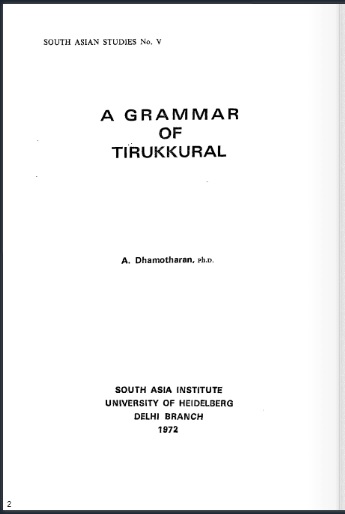
    His main research interest was the editorial work of the medieval Tamil grammatical text Naṉṉūl and its various commentaries. But, first he painstakingly collected the Thirukkural quotes employed by various commentators. He classified those quotes according to the purpose for which they were cited, and his work got published in 1970. Having published also his Grammar of Thirukkural (South Asian Studies No.5, University of Heidelberg, 1972) and a Bibliography of Tamil dictionaries in 1978, Dr. Dhamotharan prepared two fine editions of the Tamil grammatical text Naṉṉūl with the commentary by Kūḻaṅkaittampirāṉ (considered lost, till he found the mss at British library and copied it in his own, highly legible handwriting and published it as it is) in 1980 and with the Viruttiyurai commentary by Caṅkaranamacivāyar (with additions of Civañāṉa Muṉivar) in 1999. In his editorial work he was highly accurate and meticulous and showed his high degree of exact scholarship. In his 1999 edition of Naṉṉūl, Dhamotharan introduced a new feature in Tamil text editing and the format was well received in Tamil Nadu.

    In the year 2000, Dr. Dhamotharan retired from Heidelberg University at the age of 65 and one year later in 2001 he returned to Tamil Nadu. Known for his great expertise in Tamil text editing, he was invited by the Central Institute of Classical Tamil, Chennai, to participate in their project of preparing definite (critical) editions of classical Tamil texts.

    The task of preparing a critical edition of the 8th century text Iṟaiyaṉār Kaḷaviyal was entrusted to him, which he did diligently by comparing the available palm-leaf manuscripts (published in 2013). He worked as a consulting editor for the Tamil Lexicon revision project by Madras University and also for the revised and enlarged edition of Cre-A’s Dictionary of Contemporary Tamil (2008). He served as Honorary Professor at the International Institute of Tamil Studies (2001) and as a trustee of Mozhi, A Trust for Resource Development for Language and Culture, Chennai (2003–07). He brought out another edition of Kūḻaṅkaittampirāṉ’s commentary on Naṉṉūl with additions and notes (Cre-A, 2010).

    Though he had a good grounding in modern descriptive linguistics, his outlook and approach were more historical which helped him delve into the grammatical traditions of Tamil medieval commentaries.

    Because of illness he lived the last few years of his life secluded at his native place in Tamil Nadu. He will always be remembered as an excellent and patient teacher, a fine and erudite scholar and a good friend to many Tamil students and scholars both in Germany and India. He is survived by his wife and two sons. He has been blessed with granddaughters and grandsons.

    Dr. Thomas Lehmann
    South Asia Institute, Heidelberg

    Dr. P.R. Subramanian
    Mozhi Trust, Chennai

    ========================================================

    A Grammar of Tirukkural – e-book

    http://www.tamildigitallibrary.in/book-detail.php?id=jZY9lup2kZl6TuXGlZQdjZU2lJhy&tag=#book1/

    Share
  • (Peer Reviewed)“I am not a mercenary poet”: The Art of Giving in the Purananuru

    (Peer Reviewed)“I am not a mercenary poet”: The Art of Giving in the Purananuru

    Dr. M. Nazir Ali
    Associate Professor of English (Retired)
    Kanchi Mamunivar Centre for PG Studies
    Puducherry
    Orcid ID: orcid.org/0000-0002-5152-9751

    —————————————————————————————————————

    Abstract

    Giving or eekai has been a much valorised concept in classical Tamil literature and even chieftains have acquired fame much greater than that of the three great kings of ancient Tamilakam precisely because of their acts of giving. On a par with acts of valour, giving has made the giver a legendary figure. Besides, the poets and minstrels and the female entertainers known as viralis depended on this system of giving, a custom honoured by conventions. This paper looks into the intricacies of giving not only by examining the tinai and turais by which it is systematised but goes beyond them because almost every poem of the Purananuru is a praise poem. Instead of the praise becoming songs of sycophancy, the poet’s insistence on being treated with dignity transforms it into a fine art, giving us panegyrics of exemplary intricacy. Though valour and giving are not easily imagined as related acts, the paper attempts to see them as not only historically interdependent, even artistically so.

    Key words: eekai, parisitrurai, parisil katanilai, parisil vitai, paatan, attruppadai

    —————————————————————————————————————

    With the lone exception of the Invocation by Peruntevanar, almost all the poems of the Purananuru are praise poems (Marr 90). The kings and the chieftains and the other unnamed patrons find their valour or generosity and quite often both praised in these poems. The types of valour displayed on and off the battlefield follow a clearly marked system of tinais and turais – themes and situations – that I have discussed in an earlier paper[i]. The act of giving and receiving, on the other hand, has its own turais but it does not have an overarching set of rules and conventions that valour has. This want of rigidity, rather than impoverishing it, has supplied it with innumerable instances of individual giving, worthy enough to make them the stuff of legends and poetry, much more memorable than any act of bravery that the Purananuru has.

    Let me briefly cover the various tinai and turais of giving, a term I prefer to the more ponderous charity, as apt translation of eekai. The paatan tinai covers most praise poems, whether it is praise for a king’s bravery or generosity. Understandably it has the largest collection of poems. The various acts of giving and receiving come under these turais: parisitrurai, parisil vitai, parisil katanilai, paanatruppadai, pulavaratruppadai and viraliyatruppadai. Parisitrurai speaks of the king’s largesse and bards representing their needs to the patron. And it also includes reservations about accepting a gift given by a patron without knowledge of their true worth, a fact attesting to the dignity of the poets. Parisil vitai is sending off the poet laden with gifts, parisil katanilai solicits bounty from a king who keeps delaying his favour. The last three atruppadais are poems giving directions to the minstrel, poet and the danseuse respectively whose abject poverty and also itinerant lifestyle made them go in search of a patron (Marr 468-69).

    Normally referred to as eekai (giving), this attribute is valorised as kodai (munificence) and the one who displays is a vallal or a great giver. Apart from the three great kings of ancient Tamilakam, the muventar, there were also great chieftains whose fame quite often rivalled that of the kings and which proved to be a source of jealousy and war. Perunchitiranar, after listing the seven great chieftains renowned for their giving, observes that his patron Kumanan alone could fill in the void left by their deaths.

    There was Pari, the chieftain who fought his combats with kings
    while their sticks beat down on the royal drums and spotless
    bright conches were sounded, the lord of Parampu where a white fall
    of water rolling stones in its flow thunders down a tall mountain,
    and there was Ori with his powerful bow who ruled Kolli’s shining summit
    and Malaiyan, mighty in war, who was as generous as a rain cloud
    and who won his victories in battle astride his stallion Kari
    and Elini, who reigned astride his Stallion Mountain
    wearing his chaplet of kuvilam and his curving necklace, with his sharp spear,
    and there was Pekan, who ruled over a great mountain with towering summits
    watched over by an unassailable god, on its cold slopes caves full of darkness,
    and there was Ay, whom Moci, whose words are truth, has sung,
    and there was Nalli, who made his enemies flee from him, whose generosity
    was truly noble, who took it upon himself to utterly remove the poverty
    of those who came to him with desire – these seven dead,
    thinking of you now I have come here swiftly … . (158) (Hart 99-100) (My italics)*

    Tinai: Paatan   Turai: Parisil katanilai

    This poem is remarkable not only as a chronicle of the Classical Age, but also for marrying the heroism of the rulers with their generosity. The historical reason for the combination of these disparate traits might be that the conquests in the battle provided the winner with a surplus of goods because of the “Winner takes it all” policy and the spoils later got distributed to those close to them. However, there is an inherent impulse to give which transcends this material reason about which we will see later.

    The profession of composing poetry, the necessary erudition and observation it required, left little time for the poets to engage in any other occupation so that a professional poet like Kapilar could say, explaining the reason for the softness of his hand compared to the battle-hardened hands of his patron, the Cera King Valiyatan:

    You stand on your chariot
    and draw an arrow
    from the quiver on your back
    and fit it to the bowstring
    with your callused fingers.
    Your hands give gifts
    without cease to the prize winners.
    So Chief, your hands are big and powerful.
    But the hands of the one
    who sings your praises
    know only the painful skill
    of holding the staff which smells of meat,
    kindling the smoke that smells like incense
    and eating rice cooked with meat and fat
    but have no other skill – all
    of which make them soft. (Ali 14)

    Tinai: Paatan    Turai: Iyanmoli)

    One can see how Kapilar is able to harmonize the valour of his patron with his generosity as both acts contribute to the calluses in his hands. The profession of being a poet made them depend on a patron even for their daily needs, because, included in the list of objects given as prize, the reader very often finds food and beverages:

    Liquor flowed freely
    from the opened jar.
    With the slaughter of a he-goat
    there was a feast of rice and mutton.(113) (Ali 293)
    (Kapilar on Pari’s Parampu Hills)
    Tinai: Potuviyal   Turai: Kaiyarunilai

    Also, the first need of the travel-weary, itinerant poet who passed through tough terrains and harsh climates was food before he reached the safe portals of his patron. Some of the poems of Perunchitiranar present touching pictures of unimaginable poverty and hunger not necessarily overdone to evoke pity because the graphic details could not be altogether imagined:

    My mother is old. Over and over she complains about how many years
    have passed and she is still alive and her life will not end. Hobbling
    with so many small steps, a stick for an extra leg, her hair like
    spread spring, her eyesight gone, she cannot even walk to the verandah.
    And my love wears her one meagre, filthy garment and she is
    hungry and as she thinks of how things stand with her, she grieves.
    Her body is faded, her breasts withered as the many children moving
    beside her squeeze them and suck at them. In despair she plucks a young,
    half-grown shoot sprouting on a kirai plant on a garbage heap that others
    have picked near clean and she throws it into a pot without any salt
    and sets on the fire. She does not even remember when she ever
    had rice and without any buttermilk she eats the green leaves
    and complains about the Order of the World. (159) (Hart 100-01)

    (Perunchitiranar pleading with Kumanan)

    Tinai: Paatan   Turai: Parisil katanilai

    This also explains the extreme importance attached to food which in turn leads to the valorisation of farming and irrigation:

    Mighty king, who give food, give life itself,
    as the body, without water, cannot be.
    It is the food that makes up this mortal coil.
    And food comes from the union of land and water.
    Who bring water to the land
    are those who create the body and the soul. (18) (My translation)

    Poet: Kuta Pulaviyanar    Tinai: Potuviyal  Turai: MutuMoli Kanchi

    Whether the patrons really understood the historical and literary valuations in their extension of patronage to the poets is unclear. But they really valued the friendship with the poets is evident from this poem of Pandyan Neduncheliyan, winner of the famed battle fought at Talayalankanam. Here the king could be seen taking an oath to destroy his enemies and the consequences of failing to do so:

                                                                               And the poets
    praised for their great skill, Mankuti Marutan with his vast and lofty
    range of learning as well as all the others as firmly established
    as the earth, let them leave my land and sing no more about it! (72) (Hart 56)

    Tinai: Kanchi    Turai: Vanchinak kanchi

    The king not only forgoes the valued friendship of Mankuti Marutan but considers himself all the poorer for not being able to help others. This friendship with the poets manifests itself in extreme acts of giving as seen in these two poems, one by Avvaiyar and the other one by Peruntalai Saathanar. Many of Avvaiyar’s poems are on her patron and long-term friend Atiyaman Neduman Anci, ruler of Takadur (present day Dharmapuri), a friendship which is as much cherished as the one between Kapilar and Vel Pari.

    Without considering how difficult it is to obtain the sweet fruit
    of the myrobalan plant with its tiny leaves, which has to be plucked
    from a crevice on the summit of an ancient mountain hard to climb,
    you kept silence in your heart about its powers,
    and so that you might rescue me from death, you gave me that fruit! (91) (Hart 65)

    Tinai: Paatan   Turai: Valtiyal

    What Atiyaman had done was to give the life-enhancing nelli fruit to Avvaiyar, obtained after great effort, without disclosing its real worth to her. She was touched by this selfless act and the poem is her way of immortalising him. Peruntalai Saathanar, in the extremity of his poverty, approached his patron Kumanan who now lived in exile in the forest after his younger brother Ilankumanan dethroned him and also announced a reward on his brother’s head. More than the loss of his kingdom, what troubled Kumanan was his inability to help the poet in his hour of need and so he made a remarkable offer:

    “I can’t bear being so weak! When I see a great being in need, for him
    to go away without anything would be worse than losing my land!”
    So he handed me his and he offered me his head for there was nothing
    better for him to give me than himself! (165) (Hart 107)

    Tinai: Paatan   Turai: Parisil vitai

    Since then, these great acts of giving have become the stuff of legends and folklore. The legend has it that Ilankumanan became ashamed of his betrayal and restored the kingdom to his brother. The offer of oneself to alleviate the suffering of the poet is further reinforced in this poem of Kapilar praising Pari:

    Even if the singers
    come begging for his own person
    Pari, righteous soul,
    will not say ‘no’.
    He will give himself to them. (108) (Thangappa 147)

    Tinai: Paatan   Turai: Iyanmoli

    Sometimes the impulse to give seems to exceed all bounds of propriety, getting extended to the plants and birds too as it had happened in the case of Vel Pari and Vaiyavik Kopperum Pekan respectively. Pari was credited with the gift of his chariot as support to a jasmine climber as Kapilar states in a poem:

    These are the daughters of that Pari
    whose lofty virtues were known far and wide, who gave a tall chariot
    with sonorous bells, saying, “Take it!” to a jasmine vine adorned
    with flowers, so that it might climb, though the vine had never
    put scars on its tongue through singing that king’s praises! (200) (Hart 126)

    Tinai: Paatan   Turai: Parisittrurai

    Pari’s daughters were introduced to Vichiko through the act of kindness their father had shown to the jasmine vine, indication that even in Kapilar’s time it must have acquired legendary proportions. Paranar made the gift of a shawl to a shivering peacock by his patron Pekan known to the world by making it the stuff of a poem:

    Our king, Pekan, who has horses, who has elephants
    flowing with musth, once gave a garment to a peacock
    in the rain, though he knows they don’t wear clothes!
    Because he feels the poverty of others, because it is
    a virtue to give what one can, he is generous
    and not at all for the sake of a better birth in his next life! (141) (Hart 89-90)

    Tinai: Paatan   Turai: Paanatruppadai

    These extreme acts of kindness and generosity, which have now become textbook examples of Tamils’ culture of giving, may appear at first as simple-minded acts of misplaced generosity, if not downright foolish. One would like to construe them, however, as ecocritically sensitive acts spawned by a culture which fostered biodiversity as well as bioequality and which led to the creation of a whole body of Akam Poetry whose logic of tinai embraced all landscapes, seasons, animals and plants.[ii]

    If the kings and chiefs were by and large quite swift to come to the succour of the poets in need, there were a few who were a little bit tardy in rewarding them and which gave birth to a separate turai of eekai poems known as parisil katanilai:

    He welcomes us still
    as on the first of days,
    though we go there
    not just one day,
    or two days,
    but many days
    with many friends,
    does Atiyaman Anci
    of the jewelled elephant
    and the artful chariot.
    Whether the time for gifts
    comes right now
    or is put off for later,
    it’s like fodder
    left in reserve
    on the elephant’s tusk,
    always there
    at hand, waiting;
    it won’t become a lie.
    O wishful heart,
    do not scramble for it.
    Bless him,
    his works. (101) (Ramanujan 139)

    Poet: Avvaiyar Tinai: Paatan   Turai: Parisil katanilai

    Parisittrurai, though supposed to be a representation of poets to their patron on what they wanted, also has poems on how they wanted it given. It includes musings on the act of giving, a reminder to the king on the dignity that must go with giving and how in the wide world there is no dearth of patrons to the deserving poet. In brief, it inscribes the whole ideology of giving:

    It is disgraceful to beg.
    It is even more disgraceful
    not to give.
    It is ennobling to give.
    It is even more ennobling
    not to accept (204) (Thangappa 170)

    Tinai: Paatan   Turai: Parisittrurai
    (Kalaithin Yanaiyar on Valvil Ori)

    The poem goes on to compare the generous patron to a small pool of drinking water to which all come and the miser, though has wealth like the ocean, never attracts the needy. Perunchitiranar grew indignant at Atiyaman Anci when he sent him away with a gift without even seeing him. The poet insists on being treated with dignity:

    I am no money grabber[iii]
    to accept these riches
    given with indifference.
    I will accept with pleasure
    however small a gift is,
    if given with love
    and after due recognition. (208) (Thangappa 172)

    Tinai: Paatan   Turai: Parisitrurai

    Here is a poem by Avvaiyar written in anger against her patron Atiyaman Anci for the delay in giving her the gift:

    This is no empty world and all the wise
    and famous men are not dead. …
    Whether we go this way or whether we go that way, we will have rice![iv] (206) (Hart 130)

    Tinai: Paatan   Turai: Parisittrurai

    On occasions the patron treated all poets alike, a want of discernment which invited a mild rebuke from the poet as Kapilar does in this one:

    Thinking of the one in one direction
    many will come to get gifts
    from all the four.
    To know their ranks is difficult,
    giving gifts to them is all too easy.
    O mighty chief,
    if you are quite discerning
    do avoid treating all poets alike. (121) (Ali 302)

    Tinai: Potuviyal   Turai: Porun moli kanchi
    (Kapilar advising Malyaman Tirumudik Kari)

    On certain other occasions, the poet felt the need to remind his patron of life after death and how giving outlasted death:

    Even the rulers of countries go to the burning ground …
    And that day will come when you must go there as well,
    but your bad reputation will remain, and your good reputation. (359) (Hart 203)

    Poet: Kavitanar sings Antuvankiran. Tinai: Kanchi   Turai: Perunkanchi

    The poet goes on to counsel the king that giving horses and tuskers and chariots will ensure “your fame will remain here, shining and enduring.” (Hart 203) There were however patrons who preferred anonymity in giving, which made their giving all more remarkable. This poem by Vann Paranar praises Kandeerak Kopperu Nalli, one among the seven great givers, for his stubborn insistence on not disclosing his identity. He fed the poet and his starving relations with venison, gave the poet his necklace of pearls and an armlet:

    Then I asked, “What is your country?”
    but he would not tell me his country. When I asked him, “What
    is your name?” he would not tell me his name! (150) (Hart 94)

    Tinai: Paatan   Turai: Iyanmoli

    Only after asking others, the poet learnt that he was Nalli, the chief of Thotti Hills.

    Some of the patrons stunned the poets by giving gifts which far exceeded their expectations, a turai known as parisil vitai, which meant “sending off with gifts.” As if appearing to make fun of the overblown generosity of Nanjil Valluvan, Avvaiyar compliments him because all that she asked of him was only “a little bit of rice” but he had given her “a giant elephant like a hill.”

    Can one so much as imagine
    a more lopsided gesture of liberality?
    Don’t great men when they are generous show any proportion? (140) (Hart 89)

    Tinai: Paatan   Turai: Parisil vitai

    The poets, bards and other entertainers recognised themselves as belonging to a community of composers and singers and helped each other out in times of need, by directing the needy to a patron whose generosity they could rely on. These poems together form a considerable body known as “attruppadai poems” which meant “setting (the needy) in the right course.” This close-knittedness among the poets – for instance Kapilar is praised by numerous other poets – makes the idea of the existence of an academy of poets (Sangam) not a far-fetched one.

    The gratitude felt by the poets sublimated itself into innovative ways of praise. Kapilar’s very brief poem on Vel Pari comparing him to rain has become a classic in itself:

    “Pari, Pari,”
    -So go the varied praises
    of poets with fertile tongues.
    There is not only Pari
    but also rain
    to sustain this world. (107) (Ali 288)

    Tinai: Paatan   Turai: Iyanmoli 

    It will be observed that in the monsoon-dependent landscape of Tamil Nadu, the rains are vital and giving comes steeped in recurrent images of rain. The poet Mutamociyar asks, wondering at the generosity of his patron in giving elephants as prizes, “O Aai, /do the cow elephants in your land/ give birth to ten calves at a time?” (130)(Thangappa 152) There is also the image of the warrior king whose body bore multiple scars of battle and he is compared to a medicinal tree whose bark has been stripped for use in curing (180), a syncretic image of valour and giving. 

    * The number immediately after the quoted text is the number of the poem in the source text followed by pagination in the target text. The colophon gives the context where necessary. 

    —————————————————————————————————————

    Works Cited

    Ali, Nazir M. Trans. & Ed. (2016) There is also Rain: Collected Poems of Kapilar. New Delhi: Authorspress,. Print.

    Hart, George and Heifetz, Hank. Trans. & ED. (1999) The Four Hundred Songs of War and Wisdom. New York: Columbia University Press,. Print.

    Marr, John Ralston. (1985) The Eight Anthologies: A Study in Early Tamil Literature. Madras: Institue of Asian Studies,. Print.

    Ramanujan, A.K. (1999) Trans. Poems of Love and War. New Delhi: OUP,. Rpt.2013. Print.

    Thangappa, M. L.( 2010) Trans. Love Stands Alone: Selections from Tamil Sangam Poetry. New Delhi: Penguin, Print.

    Endnotes

    [i]  Refer “The Purananuru and the Tamil Concept of Valour”

    [ii] Refer “The Logic of Tinai in Akam Poetry”

    [iii] Marr translates it beautifully “I am no mercenary poet,” (188) to which my title is indebted. The source text reads like this: “Kanaatu eetha ip porutku yanor/vanikap parisilan illane”

    [iv] The condensation that Avvaiyar achieves is not even remotely attained by this translation: “Etthisai chelinum atthisai chore”

    —————————————————————————————————————

    Peer Review:

    The article entitled “I am not a mercenary poet”: The Art of Giving in the Purananuru by Dr. M. Nazir Ali, analyses extensively the eekai (charity) thurais in Purananuru such as parisitrurai, parisil katanilai, parisil vitai, paatan, and attruppadai.

    Western scholars Dr. George Hart, Dr. Ralston Marr, and Indian scholars Thangappa, A. K. Ramanujan and the author Dr. Ali’s English Translations on Purananuru are used appropriately in this article. The verses chosen for this article are magnificent, especially those written by Perunchitiranar and Peruntalai Saathanar pleading with Kumanan are soul-stirring.

    As far as poet Perunchitiranar is concerned, despite his penurious state, he refused the meager offering bestowed on him by king Ilaveliman. This poet is also praised for his feminist notions, who treated his wife with equity.

    There are no novel views regarding the verses, however, the explanations given by the author are lucid and clear-cut. In addition to this article, he has published the translation of the Ainkurunuru titled Classical Tamil Love Poetry and the collected poems of Kapilar as There is also rain. It shows his huge interest and fondness for Tamil literature which is a commendable deed indeed!

    —————————————————————————————————————

    Share
  • Why there is a walking stick?

    Why there is a walking stick?

    Dr.Annakannan

    Most of the symbols, icons, cliparts for elders are with walking stick, which I feel irrelevant. This will discourage & demotivate elders to depend on sticks.

    I see many elders without walking sticks; they will walk easily even after 70s & 80s. Elders age is starting at 60; but the need of stick may come to someone after 80 or 90, depends on their physical condition. Certain percentage of users only will use walking stick, I assume it will be around 20%. Keeping a symbol with stick for all elders will not suit.

    Better we can think some other icon for elders, which should be with cheer & celebration. I suggest United Nations to conduct an icon contest at global level to decide by online voting.

    Share
  • EFFECTIVE STUDY ON TRANSFORMATION OF MODERN LIFE  IN TO BLISSFUL LIFE THROUGH YOGA

    EFFECTIVE STUDY ON TRANSFORMATION OF MODERN LIFE IN TO BLISSFUL LIFE THROUGH YOGA

    -J.S.SUBHASHINI and Dr.V.RAMADAS

     Ph.D. Research Scholar, Associate Professor

    Department of Yoga for Human Excellence, WCSC- Vision SKY Research Center, Temple of Consciousness, Aliyar, Pollachi- 642101, Tamil Nadu

     (Email ID: subhajanani2011@gmail.com, rammarine@yahoo.in)

    *****

    ABSTRACT

    “Modern life is moving faster than the speed of thoughts, or thoughtfulness” – Rebecca Solnit

                The given maxim is absolutely right because we live in a super-fast, crowded and busy period. We have been performing multiple tasks throughout our whole day for earning more money. However, we overlook that worthy well-being is much more important for our healthy life as air and water for the physique. In earlier days, life was not so hectic. It was quite humble and free. Human beings are healthy as they had to accomplish all the daily routine activities on their own. But now, in this technological world survival has become easy and comfortable but frantic because of the competitions. Nowadays, life has become costly, hard and unhealthy as everything like air, water, environment, food, etc., has become contaminated, infected and polluted. We should never forget that our healthiness is the only prosperity of our life. It is essential to earn money for fulfilling some basic needs. But it is also required to live a healthy and peaceful life which needs good well-being. Good health needs proper rest with sleep, cleanliness, healthy environment, fresh air and water, individual hygiene and daily physical activities. Maintaining good health is for better than shunting between hospitals and home. In this modern life, retaining good health is a good custom that must be practiced from childhood. Yoga is the best lifestyle modification, which aims to attain the unity of mind, body, and spirit through asanas (exercise), pranayama (breathing), and meditation. The health of people is more important for the betterment of the future world. Hence this article deals with the transformation of one’s vague modern life into blissful life through yoga.

    Key Words: Challenges of Modern Life -Yoga Practice – Good Health-Transformation – Blissful life. 

    Introduction

    Yoga is much more than contorting a human body into different poses. It’s a technique of life. If our mind, body, and soul aren’t where we want to be, yoga can help us to improve flexibility. It lows our stress and increases our confidence, contributing to a healthier lifestyle. It is the practice that leads us to combat stress, improve physical fitness and help manage chronic disorders like pain, anxiety, and insomnia.

    Most of the people know that good health is only maintained by physical fitness, but they fail to comprehend that good mental health is also equally important. Health is not simply an absence of disease; it extends beyond the physiological aptness to psychological calmness, emotional constancy, and cheerful expressions. Moreover, body, mind, and spirit are like the steering engine and gear of the car. The malfunctioning of even one can create an imbalance in our life and lead to ill health. Yoga is the simple technique of generating coherence among these three components. Yoga is an old-style discipline with roots in the Vedic insight that eradicates filths from the levels of mind. One can get spiritual elevation through the continuous practice of yoga encompassing of meditation, pranayama, diet, and asana. It also leads an individual on the path of healthy living with greater consciousness.

    Modern Life

                Modern technology is machinery oriented. It creates life easier and saves time comparing to the old fashion way. We travel in more comfort with a number of welfares. It includes easing people’s lives, saving people from the fatal endemic diseases by the new era of medicine and vaccines. On the other hand, different modern lifestyle patterns have negative effects on health physically, psychologically, and socially. One of these modern ways of living in the high consumption of fast foods with lack of physical activity. Modern lifestyle increases the risk of obesity and leading to diabetes, heart diseases cancers and so on. Another fact is the pollution caused by machines and transport causing respiratory diseases. These are the sources for creating more stress and depression. Today our health condition, fitness, and ailments are seriously influenced by our modern lifestyle. This covers many aspects of human behaviors like patterns of eating, drinking alcohol, smoking, drug intake, human reproduction, sexual behaviours, etc. The public relationships and communications are hindered by modern lifestyle. Social isolation occurs due to spending long time on computer and internet. These conflicts should be removed from human life to lead a happy life.

    Health and Wellness

                The two concepts “Health” and “Wellness” paves more to lead a better lifestyle with good excellence. Optimum “Health” includes high level mental, social, emotional, spiritual, and physical fitness within limits of one’s heredity and individual disabilities. “Wellness” is the combination of all parts of health and fitness in the form of mental, emotional, spiritual and physical that magnifies one’s potential to live and to work successfully. This makes a significant contribution to society. Regular physical activity leads to a healthy lifestyle which can ensure an improved feeling of wellness. Only healthy people make a healthy society and country.

    Healing Through Yoga

                 Human beings are the creation with three major components, body, mind and soul. These three need health, knowledge and inner peace. Healthiness is essential for physical, knowledge for psychological needs and inner peace for spiritual need. When all the three are sufficient, there is harmony.  This harmony is reached only by Yoga. Yoga is the most ancient method of art. It is practiced for uniting of body, mind, and soul. Yoga stimulates one’s mind, emotion, soul, and body to feel happy and relaxed. It gives energy, strength and perfect health too. Regular practice of yoga with Pranayama is very much beneficial in achieving a healthy body and peace of mind. Self-realization is the greatest achievement of yoga. It is attained through meditation. An individual realizes about himself and his surroundings through systematic yoga practice. It helps in widening self-confidence, awareness, consciousness, peace of mind, better health and overall well-being. In a nutshell, yoga works on every individual life to achieve a better, healthier and perfect way of life. 

    “Yoga means union – the union of body with consciousness and consciousness with the soul.
    Yoga cultivates the ways of maintaining a balanced attitude
    in day-to-day life and endows skill in the performance of one’s actions.”
    -B.K.S. Iyengar

    Yoga is a light, which once lit, will never dim.
    The better your practice, the brighter the flame
    .
                                                                                                                -B.K.S. Iyengar

    Inhale and God approaches you.
    Hold the inhalation, and God remains with you.
    Exhale and you approach God.
    Hold the exhalation, and surrender to God.
                                                                              
    -Krishnamacharya

    The above quotes given by eminent yoga experts reveal the benefits of yoga and pranayama.

    Merits of Yoga for Blissful Life

    • Expands Flexibility
    • Builds muscle forte
    • Perfects our posture
    • Protects and strengthens our bristle
    • Enhances our bone health
    • Increases our blood flow
    • Regulates all the glands
    • Helps us to focus well
    • Lowers blood sugar and blood pressure
    • Maintains our nervous system properly
    • Releases tension in our limbs
    • Helps us to have a deep sleep
    • Boosts the human immune system functionality
    • Gives peace of mind and happiness
    • Increase your self-esteem
    • Helps us to serve others

    Conclusion

                  To sum up, modern lifestyle affects our health physically, psychologically, and socially. The essence of yoga is to make our life as efficient and enjoyable as possible in all aspects. It unlocks life’s wonder and unleashes hidden energies. The miracle transformation leads towards a blissful life if the day starts with yoga. Thus, spiritual development of an individual can be attained this Vedic practice “Yoga”.

    References

    1. K.S. Iyengar, Light on Yoga, George Allen, and Unwin, 1966
    2. Gary Kraftsow, Yoga for Transformation: Ancient Teachings and Practices for Healing the Body, Mind, and Heart, 2002
    1. https://www.yogajournal.com/meditation/make-meditation-way-of-life
    2. https://www.yogajournal.com/lifestyle/count-yoga-38-ways-yoga-keeps-fit


    Share